
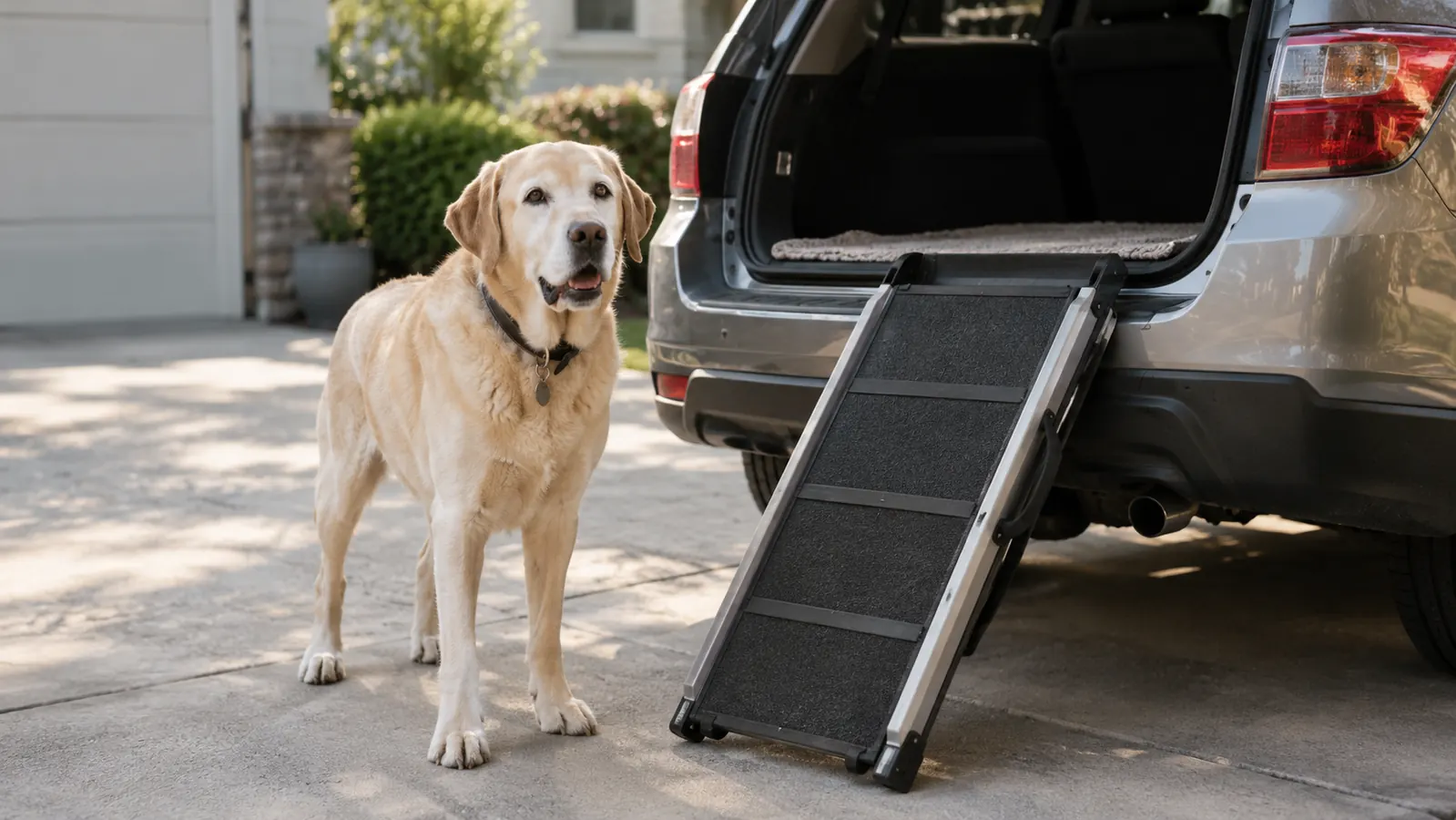
Maple is 11 years old, a 70-pound yellow Lab with stiff back hips. She started hesitating at the back porch steps around age 9, and by this spring she was planting her front feet and refusing to jump into the car. I tried a set of dog steps first because they were cheaper and easier to store. Then I bought the PetSafe Happy Ride Folding Dog Ramp and watched Maple walk up it like she had been doing it for years. This is the comparison I wish I had read before I spent money on the first option.
The short answer: for a senior dog with hip stiffness, the PetSafe ramp wins for the car, and the steps win for the couch. They solve different problems, and the right choice depends on where your dog struggles most. Here is what months of using both taught me.
| PetSafe Happy Ride Ramp | Dog Steps | |
|---|---|---|
| Best use | Car, porch, and any tall single drop | Couch and low furniture |
| Ease for a stiff-hipped dog | One gentle slope, no lifting of the back legs | Each step still asks the hips to lift and climb |
| Storage | Folds flat, fits behind a seat or in a closet | Stays assembled, takes up floor space |
| Setup time | A few seconds to unfold and place | Always ready, nothing to unfold |
| Weight | About 10 pounds, easy for me to carry | Light enough to move by hand |
| Stability on hardwood | Rubber feet held firm on my kitchen floor | Needed a mat underneath to stop sliding |
| Price | Costs more up front | Costs less up front |
Where the PetSafe Ramp Wins
The ramp wins everywhere the dog has to go up. Maple's hips are at their worst in the morning, and the first car ride of the day used to start with me lifting her back end while she scrambled with her front paws. The PetSafe Happy Ride ramp turns that into a walk. The slope is gradual enough that she can keep all four feet underneath her, and she does not have to pause and brace between steps the way she does on stairs. For a dog with stiff back hips, that is the whole ballgame.
It also wins on the porch. Our back porch has three steps, and Maple could still manage them, but she did it with a little hop at the end that worried me. With the ramp laid across the steps, she walks down at the same steady pace she uses on flat ground. I have watched her use it every day for six months and I have not seen her hesitate once. The rubber feet held firm on the concrete and on my hardwood kitchen floor, which surprised me. I expected some sliding and got none.
The morning it really clicked was a Tuesday in late April. Maple had been asleep on her bed in the kitchen, and when she got up she was stiffer than usual, taking those first few slow steps with her back end barely moving. I had the ramp out for a vet appointment, and instead of the usual dance at the tailgate, she walked straight up, turned around, and lay down before I even had the door closed. I stood there with the leash in my hand and thought about all the mornings I had spent half lifting her into that same spot. The ramp did not just help her. It changed how the whole morning felt.
Give your senior dog one gentle slope instead of three hard steps
The PetSafe Happy Ride Folding Dog Ramp is the option I reach for every single day for the car and the porch. Check today's price on Amazon and see if it fits your dog's routine.
Amazon Check Today's Price on Amazon →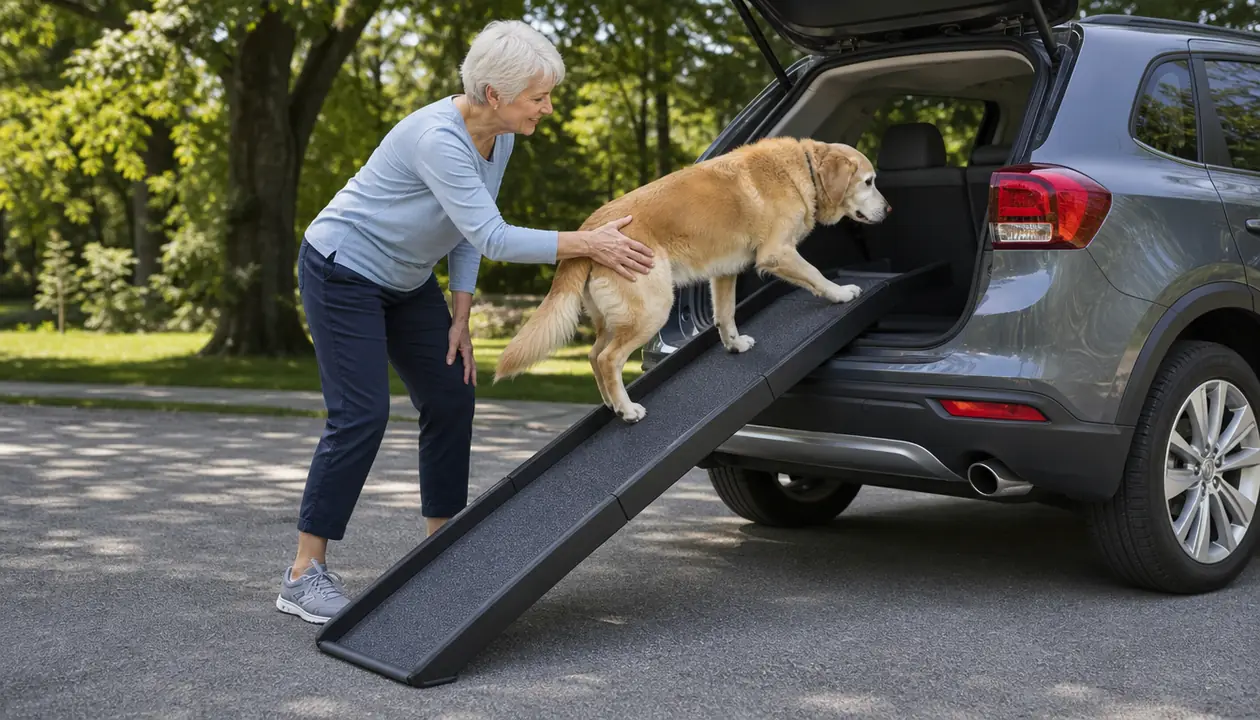
Where the Dog Steps Win
I have to be fair here, because the steps are not a bad product. They win on the couch. Maple still likes to curl up next to me in the evening, and the couch is low enough that a set of two steps gives her a comfortable path. The ramp is overkill for that job. It is long, it takes a moment to position, and on a low couch it creates a steeper angle than the steps do. For furniture, the steps are simply the better tool.
The steps also win on price and on setup time. They cost less up front, and they sit there ready to use with zero fuss. If your dog's only problem is the couch or other low furniture, I would not tell you to buy a ramp. Buy the steps, save the money, and be done. The ramp earns its keep when the drop is tall, like a car tailgate or a porch. For a 12-inch couch cushion, the steps are plenty.
Steps also take up less floor once they are in place. A ramp needs a long, clear runway in front of it, and in a small living room that can mean moving a chair or a side table. The steps sat neatly against the couch and nobody tripped over them, including my grandkids when they visit on weekends and run through the house.
I measured the couch one afternoon because I wanted to know exactly what Maple was climbing. The seat cushion is 14 inches off the floor, and the two steps split that into two smaller rises of about 7 inches each. That is a reasonable climb for her. The bed is a different story. It sits 24 inches off the floor, and the same two steps made her pause at the top every single time. She would stand there with her front paws on the mattress and her back feet still on the top step, working up the nerve to commit. She never fell, but I could see the hesitation. For the bed, I ended up using the ramp at its gentlest angle, and that worked better than the steps ever did.
Who Should Buy Which
Buy the PetSafe Happy Ride ramp if your dog hesitates at the car, the porch, or any drop that is more than about a foot tall. Buy it if your dog is heavy enough that lifting a back end is hard on your own back. I am 61 and I lift weights, but hoisting 70 pounds of Lab into an SUV every morning was wearing on me. The ramp took that job away completely. Buy it if you travel, because it folds flat and I keep mine behind the back seat of my small SUV.
Buy the steps if your dog's only struggle is the couch or other low furniture, or if you are on a tight budget and the car is not part of the problem. And if you are not sure, start with the steps for the furniture and add a ramp for the car. That is how I learned that my dog needed both.
One more thing I would tell a friend: think about where the dog spends the most time. Maple is in the car at least once a day, either for a walk at the park or a trip to the vet, and she uses the porch every time she goes out to the yard. That is two tall drops, every single day. The couch is a once-a-day comfort stop. When I added up the daily strain, the ramp was doing the heavy lifting and the steps were doing a small, pleasant job. If your dog's routine is the opposite, buy the opposite.
The ramp turned the worst part of Maple's morning, the car, into the easiest part. I have not lifted her back end into the SUV once since it arrived.
How I Tested Both
I used the steps for about three weeks before I ever tried a ramp. Maple used them for the couch, and they worked fine for that. The problem showed up at the car. The steps were too short to reach the tailgate of my SUV, and even when I angled them, the climb was steep enough that Maple braced her front feet and refused. That is when I ordered the PetSafe ramp, and the difference was immediate.
I have now used the ramp for six months, with the steps still parked by the couch. The ramp lived behind the back seat of the SUV. The steps stayed by the couch. I watched Maple's willingness, her pace, and whether she hesitated at the bottom. I also paid attention to my own back, because a mobility aid that saves the dog but hurts the owner is only half a solution.
I kept a little notebook on the kitchen counter for the first month, which sounds like overkill but turned out to be useful. I wrote down the date, whether Maple hesitated, and how long the whole trip from the house to the car took. On the days we used the steps at the car, she balked four times out of five and I ended up lifting her. On the days we used the ramp, she walked up without stopping. The notebook made the pattern obvious in a way my memory would have smoothed over. I am a PE teacher, so I trust a written record over a feeling.
What Nobody Tells You About Ramps
The first thing is that a ramp takes up space while you use it. It is not a permanent fixture like steps. You unfold it, place it, and fold it back up when you are done. That is a small chore, and it is the tradeoff for the gentle slope. The second thing is that some dogs are nervous about the texture or the angle at first. Maple needed a few days, and I have heard from friends whose dogs needed a week of treats and patience. Give it time.
The third thing is that a ramp is not a cure for joint problems. It is a comfort tool. It removes the strain of climbing, but it does not fix the hips underneath. I still take Maple to the vet, I still keep her on the joint supplement our vet recommended, and I still watch her weight. The ramp made her daily life easier. It did not make her young again, and no product will.
The second thing is that training takes a few days, and it goes faster with treats and patience than with pulling. I laid the PetSafe ramp flat on the grass first and let Maple walk across it on a leash, then raised one end onto the porch step, and only then tried the car. By the third day she was walking up on her own. Rushing that first week is the most common way people decide a ramp does not work for their dog.
I also learned that placement matters more than I expected. The ramp needs a little room to breathe. I tried using it in a narrow hallway once, and the angle came out too steep for Maple to feel confident. When I moved it to a spot with more open floor, she walked up without a pause. The same is true at the car. I park in the driveway, and I angle the ramp so the bottom sits on the flattest part and the top reaches the tailgate. It takes an extra ten seconds, but it makes the difference between a slope Maple trusts and one she eyes with suspicion.
The one mobility tool I would not give back
If your senior dog struggles with the car or the porch, the PetSafe Happy Ride Folding Dog Ramp is the purchase that changed our routine. Check today's price on Amazon.
Amazon Check Today's Price on Amazon →