
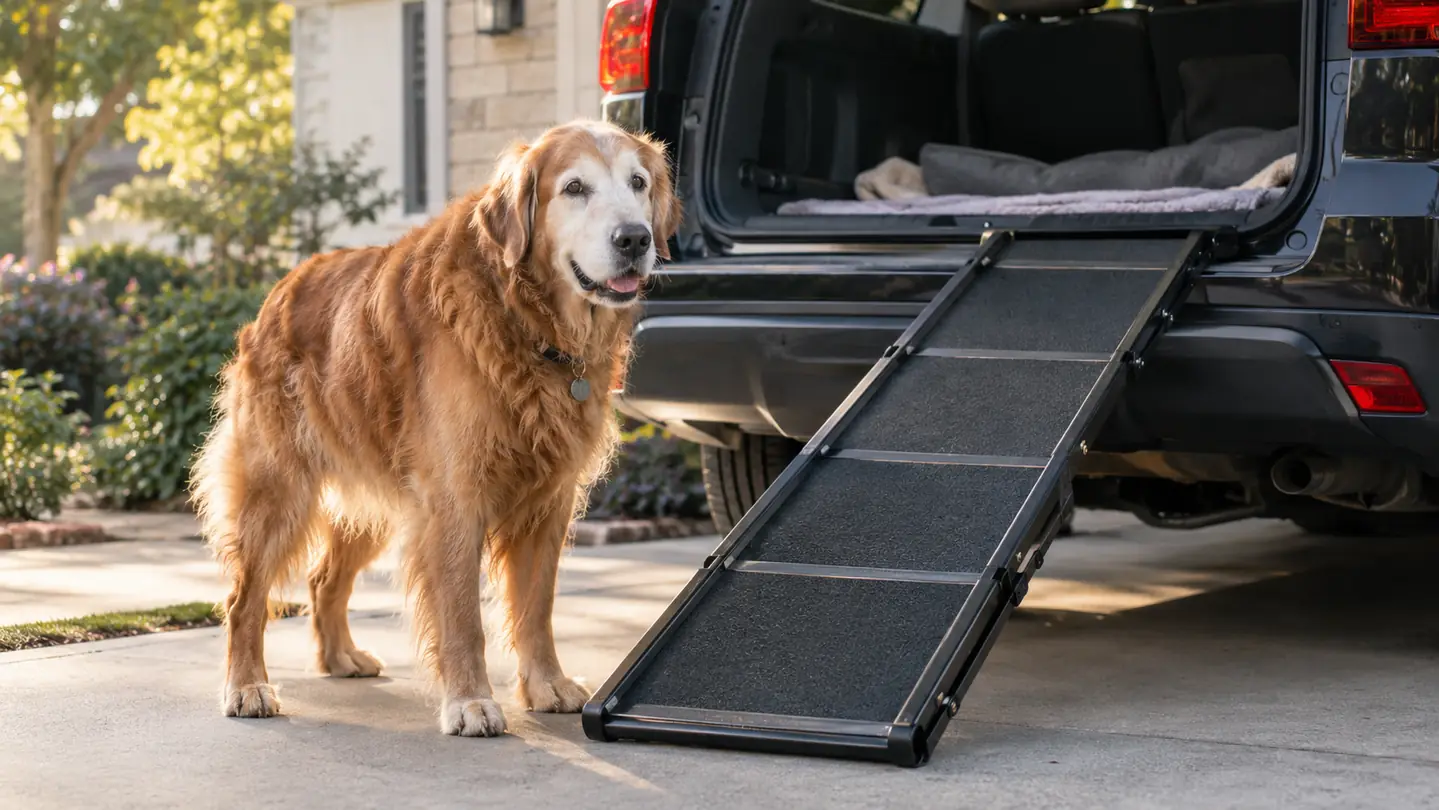
Maple is 11 years old, a yellow Lab pushing 70 pounds, and she has spent the last two years letting me know exactly where her hips hurt. She still greets me at the door, still patrols the backyard, still plants herself in the kitchen doorway whenever I am cooking. But the car had become a problem. She would stand at the open tailgate, front paws on the bumper, and just wait. Not whining, not barking. Waiting, the way a kid waits at the edge of the diving board when the water looks too far down. I am Glenda Pruitt, a retired PE teacher in Lexington, Kentucky, and I have spent my whole career watching people avoid movements that hurt. Maple was doing the same thing, and it broke my heart a little every time I had to lift her back end into the SUV.
That is why I bought the PetSafe Happy Ride Folding Dog Ramp. Six months later, after using it almost daily for vet runs, grandkid pickups, and our two-mile morning walks, I can tell you exactly what it does, what it does not do, and whether it is worth the money for your dog. Short version: it changed our routine, but it is not magic, and there are a few things I would want you to know before you order one.
The Quick Verdict
The PetSafe Happy Ride Ramp turned our hardest daily moment into the easiest one. It is sturdy, folds flat, and my 70-pound Lab walks up it without help. It is not the cheapest ramp and it takes a little practice to set up, but for a senior dog with stiff hips, it has been worth every penny.
Amazon Check Today's Price →Stop Lifting Your Senior Dog Into the Car
If your dog hesitates at the tailgate the way Maple did, a ramp is the kindest fix you can buy. The PetSafe Happy Ride Ramp folds flat, holds up to 150 pounds, and gives your dog solid footing instead of a jump that hurts.
Amazon Check Today's Price on Amazon →How I've Used It
I want to be clear about the setup, because the first time I unfolded this thing I felt like I was wrestling a very polite accordion. The PetSafe Happy Ride Ramp comes folded in half. You release two locking mechanisms, swing the two sections flat, and slide the extension piece out to reach the ground. The whole process took me maybe ninety seconds the first time. By week two, I could do it in about twenty seconds, which matters when you are standing in a parking lot with a dog who is losing patience.
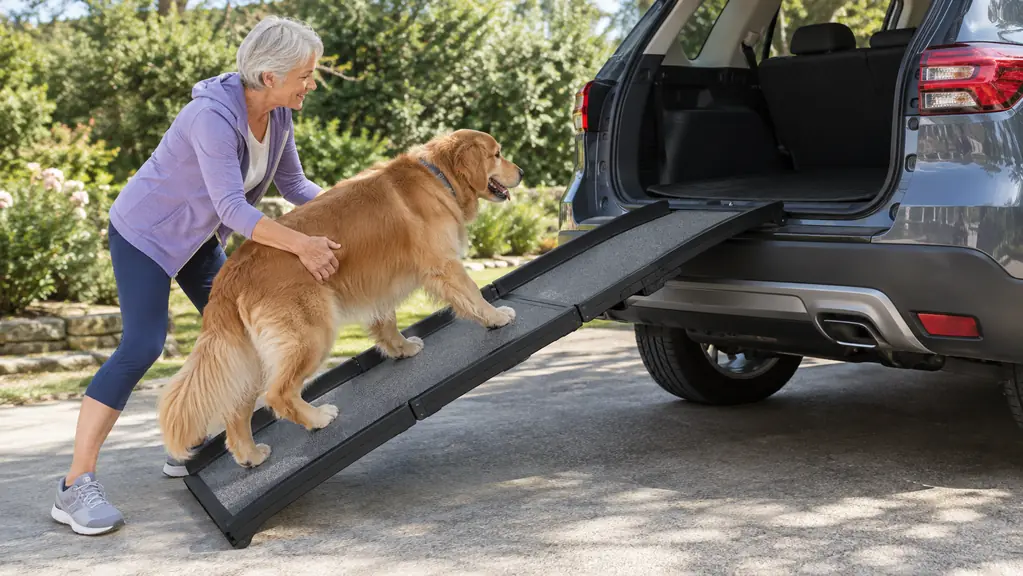
The ramp has a textured surface with raised ridges, and the sides are slightly raised so a dog does not step off the edge. It is 62 inches long unfolded, which sounds like a lot, but that length is exactly why the slope is gentle enough for an old dog. Maple was wary of it for the first few days. By the end of the first week, she was trotting up it on her own. I use it on our small SUV, and the ramp rests on the bumper with rubber grips that keep it from sliding. I have also used it on my daughter's taller crossover, and it worked there too, just at a steeper angle.
I keep it folded in the back of the SUV, standing against the seat. It takes up about as much room as a folded lawn chair, maybe a little more. It weighs about 10 pounds, which I can manage, but I will be honest: if you have back problems yourself, you may want to keep it stored near the car door rather than deep in the garage. The carrying handle helps, and the whole thing is light enough that I move it in and out without thinking about it now.
Why Maple Started Hesitating in the First Place
Around age nine, Maple started pausing at the back porch steps. Then she started pausing at the car. Our vet explained it the way I used to explain shin splints to a teenager: when a joint hurts, the body learns to avoid the movement that triggers it. For a big dog, jumping into an SUV is a lot of impact on the back hips. Maple was not being stubborn. She was being smart. She had figured out that the jump hurt, so she stopped jumping.
I tried a few things before the ramp. I tried lifting her back end, which worked but was hard on my own back and made her nervous. I tried a set of pet steps, but they were too short to reach the tailgate. I tried parking on a curb so the tailgate was lower, which helped a little but was not always possible. The ramp was the first solution that let her walk into the car the way she used to, with all four feet underneath her and no help from me.
I want to say something important here, the same thing I tell every parent at the start of a school year: check with your vet before you assume what is going on. I am not a veterinarian. I am a retired PE teacher who has spent a lot of years watching bodies move, and I know that a dog hesitating at the car is usually telling you something. But the something could be hips, could be knees, could be arthritis, could be something else entirely. I checked with our vet before we started. That is the right order of operations.
What Six Months of Daily Use Taught Me
The first thing I noticed was that Maple stopped hesitating at the tailgate. Not overnight, but within a couple of weeks. She now walks up the PetSafe ramp the way she walks up the porch steps: no pause, no look back at me, just up and in. The ramp has become part of her routine, and dogs are creatures of routine. She knows the routine now: open the tailgate, unfold the ramp, wait for the click, walk up, get the treat. The treat helps, but I think the predictability helps more.
The second thing I noticed was that she seemed more willing to go places. That sounds small, but for a dog who had started turning her head away when I grabbed the car keys, it was a big deal. We go to the vet, we go to the park, we go pick up the grandkids on weekends. Maple is their favorite, and they would be heartbroken if she stopped coming along because the car hurt. The ramp did not cure her hips. Nothing is going to cure eleven years of wear and tear. But it removed the one part of the outing that hurt, and that changed everything.
The third thing I noticed is that the ramp has held up. Six months of daily use, rain, mud, dog nails, and the rubber grips on the bottom are still intact. The textured surface still gives Maple traction even when her paws are wet. The locking mechanisms still click firmly. I have not had to tighten anything or replace anything. For a product that lives in the back of an SUV and gets dragged out twice a day, that is a solid track record.
Maple stopped hesitating at the tailgate within two weeks. She now walks up the PetSafe ramp the way she walks up the porch steps: no pause, no look back, just up and in.
The Details That Matter
Let me give you the specifics that I wish someone had told me before I bought it. The PetSafe Happy Ride Ramp is rated for dogs up to 150 pounds, which is more than double Maple's weight and reassuring. The surface is a textured plastic with raised traction ridges, and the side rails are raised just enough to keep a dog's feet on the ramp. The extension slides out to adjust the length, which is how you get the gentle slope. The whole thing folds in half and locks closed, and there is a carrying handle in the middle.
The ramp is 62 inches long unfolded, about 16 inches wide, and the walking surface is wide enough for a 70-pound Lab to feel secure. Maple is not a dainty stepper. She is a dog who barrels through life, and she has never once slipped or stepped off the edge. The rubber feet on the bottom grip the ground and the bumper, so the ramp does not slide when she is on it. That was my biggest fear, honestly, that the ramp would shift mid-step and scare her off it forever. It has not moved a millimeter in six months.
One thing to know: the ramp is not a single solid piece. It is two sections that lock together, and there is a slight seam where they meet. Maple has never noticed it, and I have never felt it flex under her weight, but if you are the kind of person who runs your hand over everything, you will feel the seam. It has not been an issue for us, but I mention it because I would rather you hear it from me than discover it yourself and wonder if something is wrong.
Where the PetSafe Ramp Falls Short
I promised you an honest review, so here is the honest part. The PetSafe Happy Ride Ramp is not perfect, and there are three things I would change if I could. First, the setup takes practice. The first few times, I fumbled with the locking mechanisms and the sliding extension. It is not hard, but it is not as instant as the ads make it look. Give yourself a week of practice before you need it in a hurry.
Second, the ramp is bulky when folded. It is not heavy, but it is long, and it takes up real space in the back of an SUV. If you already pack your car to the ceiling for road trips, you will be rearranging things. I keep it standing against the back seat, and it is always the first thing I grab and the last thing I put back. Third, the price. The PetSafe ramp costs more than a set of pet steps, and if your dog is small enough to use steps comfortably, steps might be the smarter buy. For a big dog with hip stiffness, the ramp is worth the extra money, but I am not going to pretend it is the budget option.
What I Liked
- Gentle slope that a 70-pound senior Lab walks up without help
- Folds flat and locks closed, easy to store in the back of an SUV
- Textured surface and raised side rails give a nervous dog solid footing
- Rubber grips on the bottom keep the ramp from sliding on the bumper
- Holds up to 150 pounds, so it will work for most large breeds
- Six months of daily use and no signs of wear
Where It Falls Short
- Setup takes practice the first few times
- Bulky when folded, takes up real space in the car
- More expensive than pet steps, which work fine for smaller dogs
- Two-piece design has a slight seam where the sections meet
Who This Is For
The PetSafe Happy Ride Ramp is for anyone with a large or senior dog who has started hesitating at the car. If your dog is slowing down, if they pause at the tailgate, if you have found yourself lifting their back end more than you would like, this ramp is worth a serious look. It is also for people who want to protect their own backs. I am 61 years old, and lifting a 70-pound dog into an SUV is not a job I want to do forever. The ramp does that job for me, every single time, without complaint.
It is also for people who travel with their dog. We take Maple to visit family a few times a year, and the ramp comes with us. It folds flat enough to fit in the car, and it means Maple can get in and out of unfamiliar vehicles without me having to scout for a curb or a hill. That independence is worth more than I can say. She does not have to wait for someone to lift her. She just walks up the ramp, the same way she has walked up a thousand ramps at home.
Who Should Skip It
If you have a small dog who can use pet steps comfortably, you do not need this ramp. Steps are cheaper, take up less space, and are easier to set up. The PetSafe ramp is built for bigger dogs who need a gentler slope, and for small dogs, the slope is overkill. If your dog is young and still jumping into the car with enthusiasm, you also do not need it yet. A ramp is a tool for protecting joints, and if your dog is not showing any hesitation, you may be solving a problem you do not have.
And if you are not willing to practice the setup, this might frustrate you. The ramp is not complicated, but it is not a one-second unfold. It takes twenty seconds once you know what you are doing, and if that sounds like too much, a set of steps or a lift harness might fit your life better. There is no shame in that. The best tool is the one you will actually use every day, and if the ramp feels like a hassle, you will stop using it, and then it is just an expensive thing taking up space in your garage.
Give Your Senior Dog the Gift of Easy Rides
Six months in, the PetSafe Happy Ride Ramp is the best money I have spent on Maple's comfort. If your dog hesitates at the car, do not wait until they stop wanting to go places at all. Check the current price on Amazon and see if it fits your routine.
Amazon Check Today's Price on Amazon →