
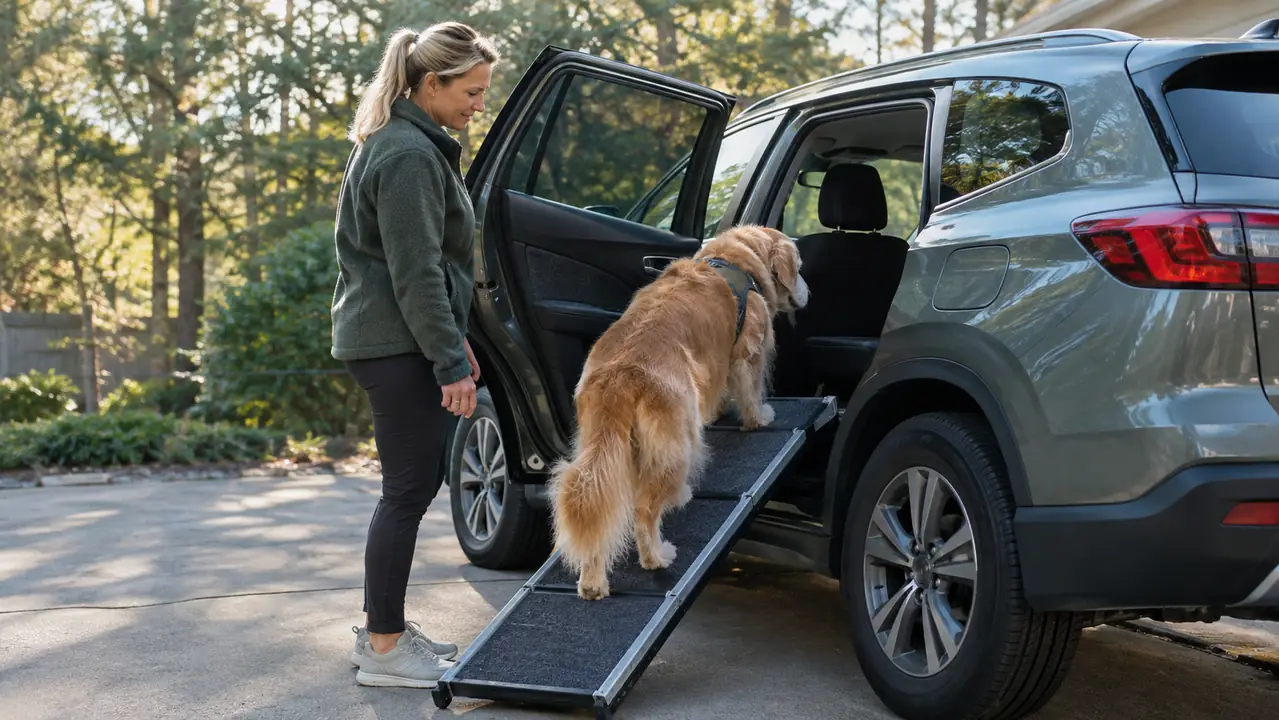
Maple started refusing the car when she was about nine. She would stand at the open door, front paws on the seat, and just look at me. Not stubborn, not scared. Hesitant. Her back hips had been stiff for a while, and I think she knew the jump was getting harder than it was worth. I am Glenda Pruitt, a retired PE teacher in Lexington, Kentucky, and I spent thirty years watching kids decide whether to try something based on how much it hurt. Maple was doing the same math. The PetSafe Happy Ride Folding Dog Ramp is the tool that changed that math for her, and this is the exact routine we use now, step by step.
I am not a veterinarian, and nothing here replaces a checkup. We talked to our vet before we changed anything, and you should too. What I can give you is the routine that worked for a 70-pound yellow Lab with stiff hips, a small SUV, and a driver who does not want to lift 70 pounds of dog anymore.
The car was the first thing that tipped me off that Maple was slowing down. The porch steps came next, then the jump onto the couch, which she stopped attempting altogether. Each one was small. Together they told me that her back end was not what it used to be, and that the things she had done her whole life without thinking now required a decision.
Skip the Lift. Let the Ramp Do the Work.
The PetSafe Happy Ride folding ramp has carried Maple in and out of our SUV every day for months. It folds flat for storage, sets up in seconds, and it might save your back too. Check today's price on Amazon.
Amazon Check Today's Price on Amazon →Step 1: Set Up on Level Ground Before You Bring the Dog Out
The biggest mistake I made at first was trying to set the ramp up while Maple stood beside the car, tail wagging, ready to go. The ramp slides, the car door is in the way, and now the dog is watching you wrestle with something that looks flimsy. That is the wrong first impression.
Now the ramp comes out of the back of the SUV before Maple even leaves the house. I set it on the driveway, on flat ground, and give it a quick once-over. The PetSafe Happy Ride ramp unfolds and locks in a few seconds, but I still check that the hinge is seated and the feet are planted. If the surface is wet, I dry it or move the setup to a dry patch. A ramp that slips under your dog's paw is a ramp your dog will never trust.
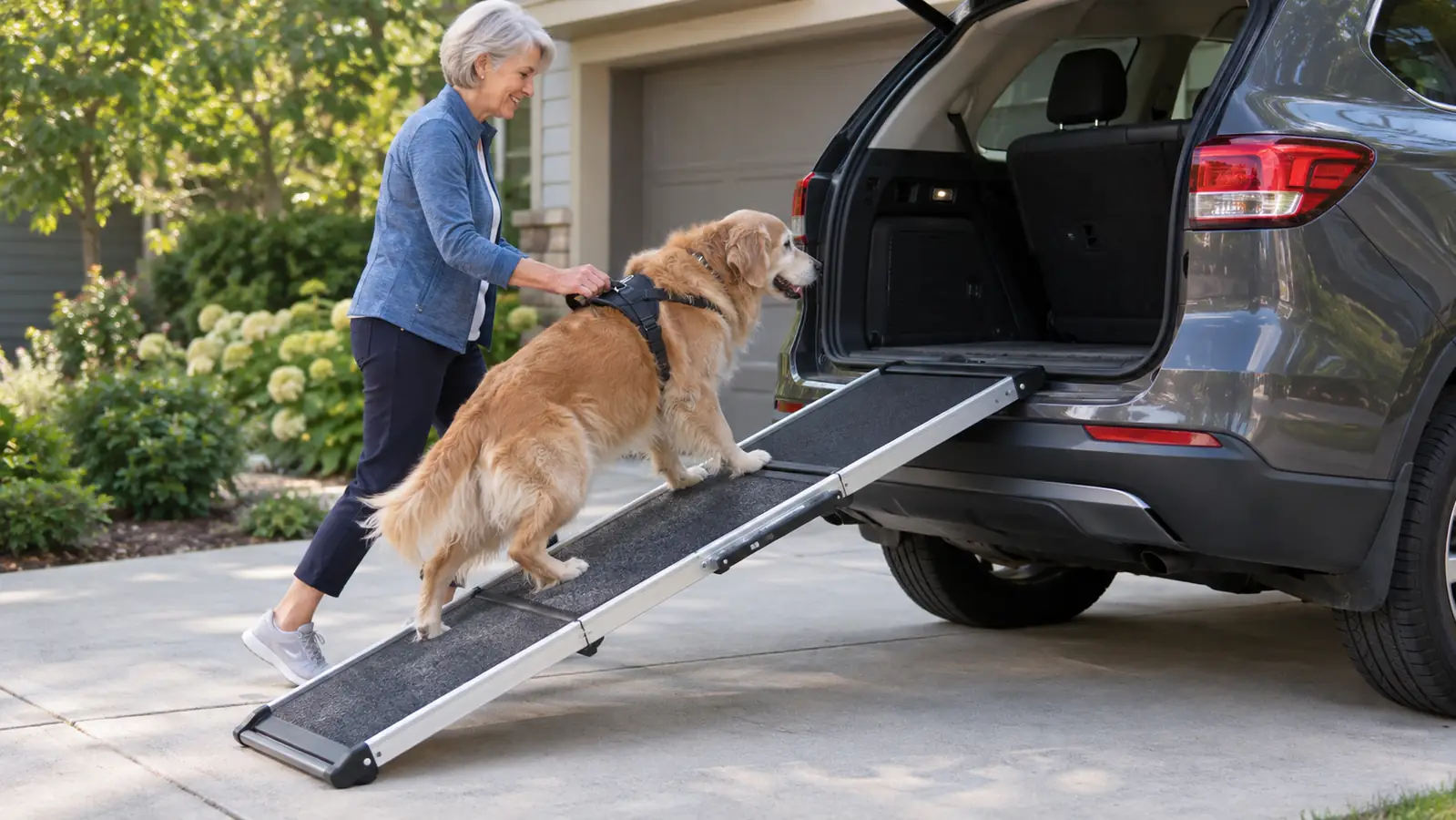
For a small SUV like mine, I angle the ramp toward the rear tailgate, with the top resting on the bumper. That gives me the longest run of level driveway and the least angle for Maple to climb. You want the ramp as close to flat as you can manage. More on that in a minute.
Step 2: Let Her Meet the Ramp in the Yard, Not at the Car
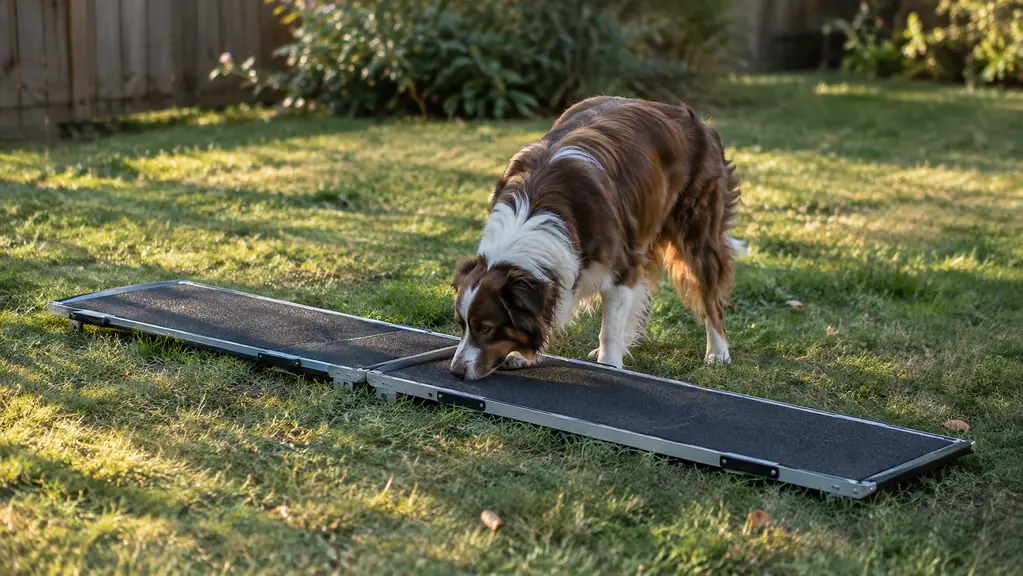
This is the step most people skip, and it is the one that saves you the most frustration. Before Maple ever had to use the ramp to get into the car, she walked across it on the grass for a week. I laid it flat on the lawn, put a couple of treats on it, and let her discover it on her own terms.
Start with the ramp completely flat on the ground. Walk your dog over it a few times. Put a treat at the far end. Let her stand on the middle. The goal is for the ramp to become boring, the same way a balance beam becomes boring for a kid who practices on it every day. In PE, I never started a kid on the high beam. We started on the line painted on the floor. Same idea.
Once she was comfortable with it flat, I propped one end on the bottom porch step. Three steps, low height. She walked up and down that for a few days. Do not rush this step. I know you want to get to the car and be done with it, but the car is where the pressure lives. The yard is where confidence gets built. Ten minutes a day for a week costs you nothing. By the time we moved to the car, the ramp was just another thing on the ground, not a scary new object that happened to be attached to the car.
Step 3: Use the Lowest Angle You Can Manage
Here is the physics, in plain teacher terms. The closer the ramp is to flat, the less work your dog's back legs have to do. Maple's hips are stiff, and a steep ramp makes her use the muscles that hurt. A shallow ramp lets her use her front end and walk up more like a hill than a ladder.
To get a lower angle, I park so the tailgate opens onto the widest part of the driveway. Then I extend the ramp as far out from the car as the setup allows. The PetSafe Happy Ride ramp is long enough that I can get a decent angle without blocking the whole driveway. If your car sits high and the angle still looks steep, look for a curb or a low spot in the driveway to put the ramp's feet on. Every inch of height you take off the ramp end helps. The ramp surface matters more than I expected too. Maple's paw pads are not what they were when she was five, and on a wet morning the surface can be slick. I keep a small towel in the car and give the ramp a quick wipe before she walks up. It takes ten seconds and it has prevented exactly one bad moment that I do not care to repeat.
You will know the angle is right when your dog walks up without pausing at the top. If she stops and looks back at you, the angle is too steep. Do not push her through it. Adjust the setup, lower the ramp, and try again.
Step 4: Walk Beside Her, Don't Lift Her
Here is what I learned the hard way. The first few times, I stood behind Maple and sort of guided her rear end with my hands, ready to catch her if she stumbled. That made things worse. My hands on her back made her feel unstable, and she stopped trusting her own feet.
Now I stand at her shoulder, on the side away from the car, and walk up beside her. I keep one hand lightly on her collar or her harness, not pushing, just steadying. If you use a harness, put your hand on the handle at the top of the back, not on the sides. That keeps your arm out of her leg path and gives her something solid to lean into if she stumbles. Maple has only stumbled once on the ramp, and the handle is the reason she did not come down hard. I talk the whole way. 'Good girl, you've got it, almost there.' The talking is not for her, it is for me, because my voice stays calm when I am talking.
A word about lifting, because I know someone reading this is still lifting their dog into the car. I did it too, until Maple hit about 65 pounds and I felt something in my own back that I did not like. Lifting a heavy dog into a tall SUV is how people hurt themselves and their dogs. The ramp is not a slower version of the same job. It is a different job. Your dog walks, you walk, nobody gets lifted.
Step 5: Make It the Same Routine Every Single Time
Maple does best when the car routine never changes. Same door, same ramp position, same order of events. Dogs are creatures of routine, and senior dogs especially. When the sequence is predictable, she does not have to think about it. She just does it.
Our routine looks like this. Ramp out first. Door open. Ramp set and checked. Maple walks over from the yard, sniffs the ramp once, walks up, turns around in the back seat, lies down. Then I close the door, fold the ramp, and put it in the back. Total time, maybe ninety seconds. When we get home, the whole thing runs in reverse.
Give it a few weeks before you judge whether it is working. The first week, Maple still hesitated at the bottom of the ramp. The second week, she paused at the top. By the third week, she was walking up like it was the porch steps. Consistency over gimmicks. That was my whole teaching philosophy, and it turns out it works on dogs too. One more note about routine. Part of the routine is watching her. I notice when she pauses at the bottom of the ramp, because that pause is information. Sometimes it means the angle is off. Sometimes it means her hips are having a rough day and she needs a minute. I have learned to read the difference, and I always tell people to learn their own dog's version of that pause.
Why This Routine Matters
The first time Maple walked up the ramp and into the car without hesitating, I stood in the driveway feeling a little silly for how happy it made me. It was just a ramp. But it was the first time in months that she had gotten into the car without me holding my breath, and the first time in longer that she had done it under her own power. That matters when your dog is eleven.
I have had neighbors tell me they still lift their dogs into the car because they do not want to give up on them. I understand the feeling. But giving up on something is not the same as making it easier. Making it easier is how you keep doing the things you love together, like trips to the park and the vet and the grandson's soccer game. The ramp is not giving up. It is the opposite of giving up.
What Else Helps
The ramp is not the whole answer, and I would be doing you a disservice if I pretended it was. A harness with a handle on the back gives you something to hold without grabbing her ribs. A checkup with your vet rules out anything serious, because stiffness can be many things and only your vet knows which one. A short warm-up before the car, even a slow lap around the yard, keeps her hips from starting cold. And trimming the hair between her paw pads, which I never thought about until our groomer mentioned it. Slippery paws on a ramp are a problem you can fix in five minutes with scissors.
A ramp protects your dog's joints better than a jump.
One thing I will not do is tell you the ramp will fix her hips. It will not, and nothing will. What it does is remove one more hard thing from her day. At eleven, Maple has earned a life where getting into the car does not have to hurt. That is the whole goal, and it is a good one.
Every dog is different, and your ramp routine will not look exactly like mine. That is fine. Take the parts that fit, leave the parts that do not, and check with your vet before you start. The goal is the same either way: a dog who can get in the car without pain and a person who does not have to lift her.
The ramp is not a slower version of the same job. It is a different job. Your dog walks, you walk, nobody gets lifted.
Start With the First Step Tonight
You do not need to train for a week before you try the ramp. Set it up flat in the yard, let your dog sniff it, and go from there. The PetSafe Happy Ride ramp is the one we use every day, and it is the one I would buy again. Check today's price on Amazon.
Amazon Check Today's Price on Amazon →