
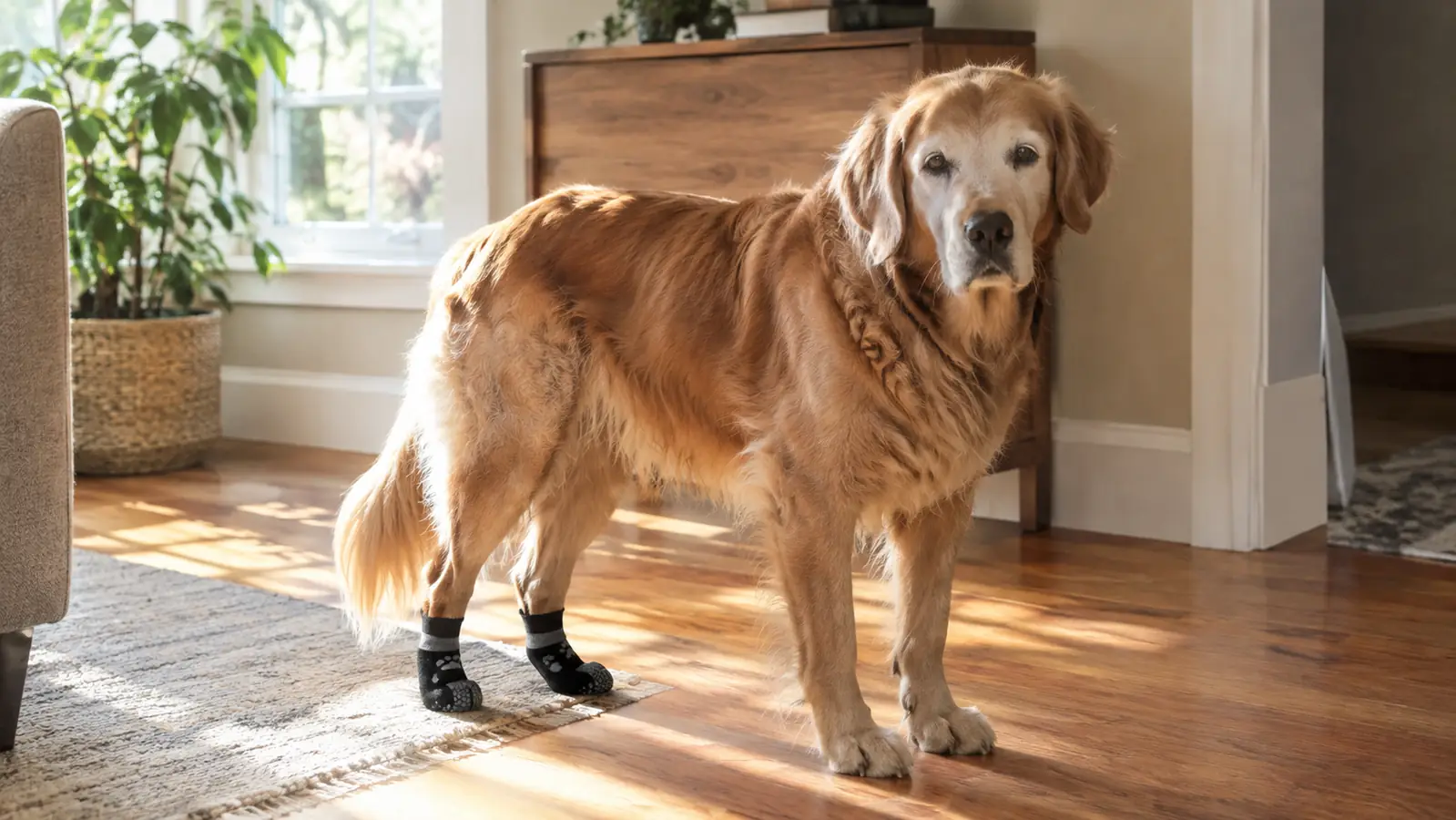
The first time Maple slipped on our kitchen floor, I heard her nails slide before I saw her legs go. She caught herself, but just barely, and for the next hour she moved through the kitchen like the floor might shift under her again. That was two years ago, when she was nine. Maple is an 11-year-old yellow Lab, about 70 pounds, with stiff back hips and a habit of hesitating before she commits to a step. A dog that size does not fall gracefully, and every close call on hardwood made me a little more anxious about leaving her alone in the house.
I tried rugs, which slid. I tried mats by the back door, which she stepped around. I tried paw wax, which helped on the porch but did almost nothing on the smooth kitchen floor. What finally worked was a pair of DOK TigerToes non-slip dog socks, and the change showed up in the first week. But the socks only worked because I built a routine around them. Here is the exact process I used, step by step, so you can skip the trial and error I went through.
Give your older dog traction before the next slip
The DOK TigerToes socks I use on Maple are the ones that finally stopped her back paws from sliding on the kitchen floor. They are the first thing I reach for before her morning walk, and they are easy to put on once you know the routine. Check today's price on Amazon and see if they fit your dog's routine.
Amazon Check Today's Price on Amazon →Step 1: Watch Your Dog Move Before You Buy Anything
Sit on the floor where your dog actually walks and watch. Not at the park, not in the yard, but on the surface that worries you. I spent one afternoon in the kitchen watching Maple turn around at her food bowl, and I noticed she braced her back legs every time she changed direction. Her front paws were fine. It was the back paws that slid, which made sense given the stiffness in her hips. She was using her front legs to pull herself along and hoping the back ones would follow.
Maple's trouble spots were the kitchen and the hallway, both hardwood, both on the way to things she wanted. The back porch steps were a separate problem, and I dealt with those by slowing down and helping her, but the indoor floors needed something on her feet, not on the house. Watching first saved me money, because I almost bought a set of rugs that would have covered the whole hallway and still slid under her when she changed direction quickly. Know exactly where your dog slips before you choose a fix.
This is the part most people skip, and I understand why. It is not exciting to sit on the floor and watch your dog walk in circles. But the observation told me something important: Maple was not slipping everywhere, she was slipping in specific spots, at specific moments, usually when she turned or when she first stood up. A fix that targets the actual problem is always smaller and cheaper than a fix that guesses.
Step 2: Measure All Four Paws and Order the Right Size
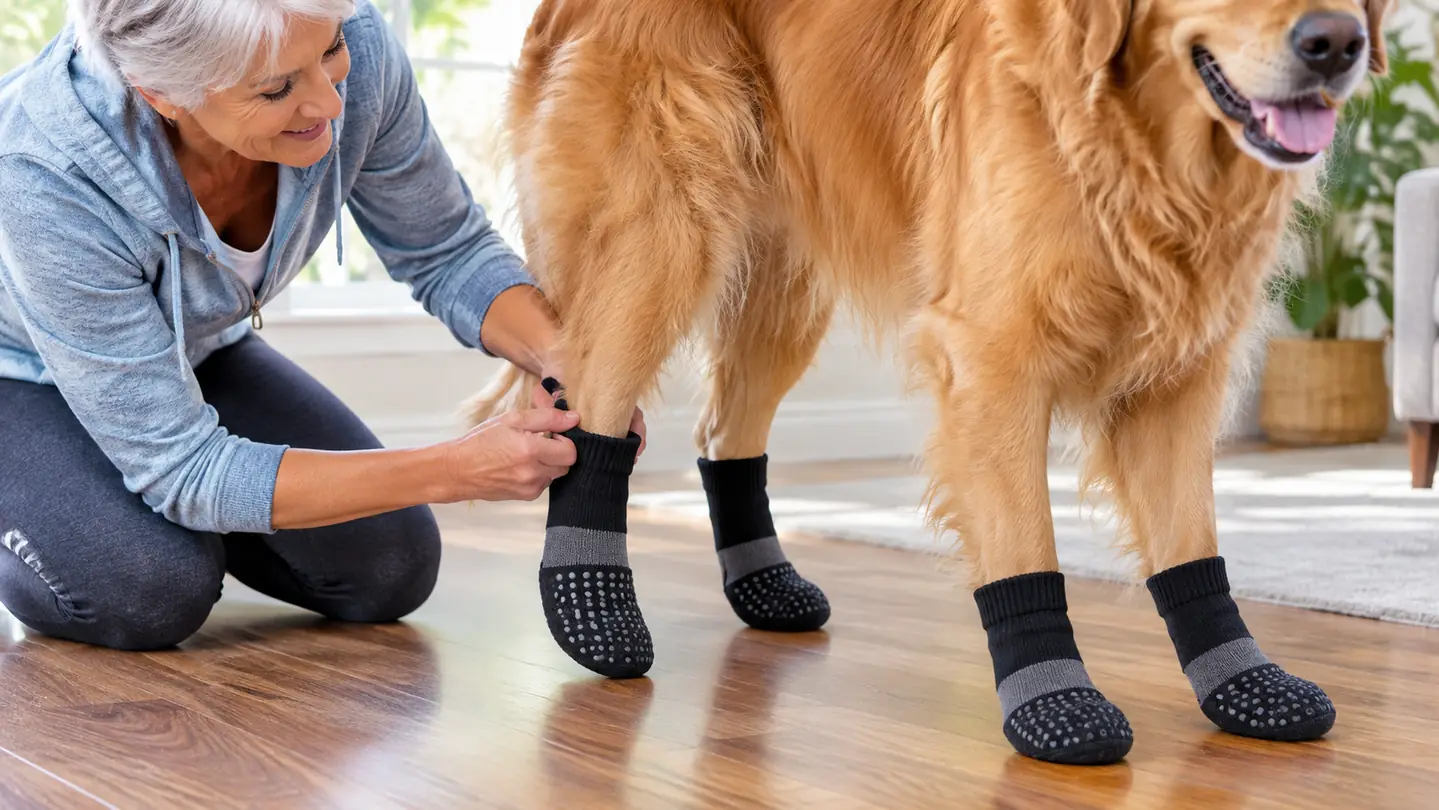
Grip socks only work when they fit, and a sock that is too big will slide right off the moment your dog walks. A sock that is too small will bunch up between the toes, which is worse. I measured all four of Maple's paws while she was standing, because a standing paw is wider than a paw on the ground when she is sitting. I traced each paw on a piece of paper and measured the widest part. Her front paws were noticeably bigger than her back paws, which meant I needed a size that covered her front feet without being baggy on the back.
The DOK TigerToes listing has a size chart, and I checked it against my tracing before I ordered. If your dog sits between sizes, I would size up and adjust the fit rather than squeeze into the smaller one, because a tight sock bunches and a bunched sock is a trip hazard. I also ordered two pairs. The first pair let me wash one set while Maple wore the other, and the second pair gave me a spare when one sock went missing in the yard for two days. It turned up under the porch, which tells you how easily a sock can wander off.
One more thing about sizing: check the socks the day they arrive, before you need them. I put one on Maple's paw right away, walked her a few steps, and watched how the fabric sat. It took me two tries to get the size right across all four paws, and I was glad I did it on a Tuesday afternoon instead of at 7 a.m. on a cold morning when she was already stiff and waiting for breakfast.
Step 3: Introduce the Socks Slowly, One Paw at a Time
The biggest mistake I made at the start was trying to put all four socks on at once. Maple took one look at me coming at her with four tubes of fabric and left the room. So I slowed down. Day one, I showed her one sock, let her sniff it, gave her a treat, and put it on one back paw for about ten minutes while she sat on her bed. She shook her foot once, decided it was not worth leaving the bed over, and went back to sleep.
Think of it like the first week of a PE class. You do not throw a kid into a full game on day one. You build up the skill, then the confidence, then the endurance. The same principle applies to an older dog who has never worn anything on her feet. By day three, Maple would hold up a paw for the sock before I even asked. By day five, she was walking across the kitchen with all four socks on, and the only thing she seemed confused about was why we had not been doing this all along.
If your dog really will not keep socks on, do not force it. Some dogs hate the feeling and no amount of treats will change that. I would rather have Maple walk slowly on a rug than fight her into a sock every morning. But give the slow introduction a full week before you decide. The first two days are the hardest, and most dogs settle into it faster than you expect.
Step 4: Do a Fit Check Before Every Wear
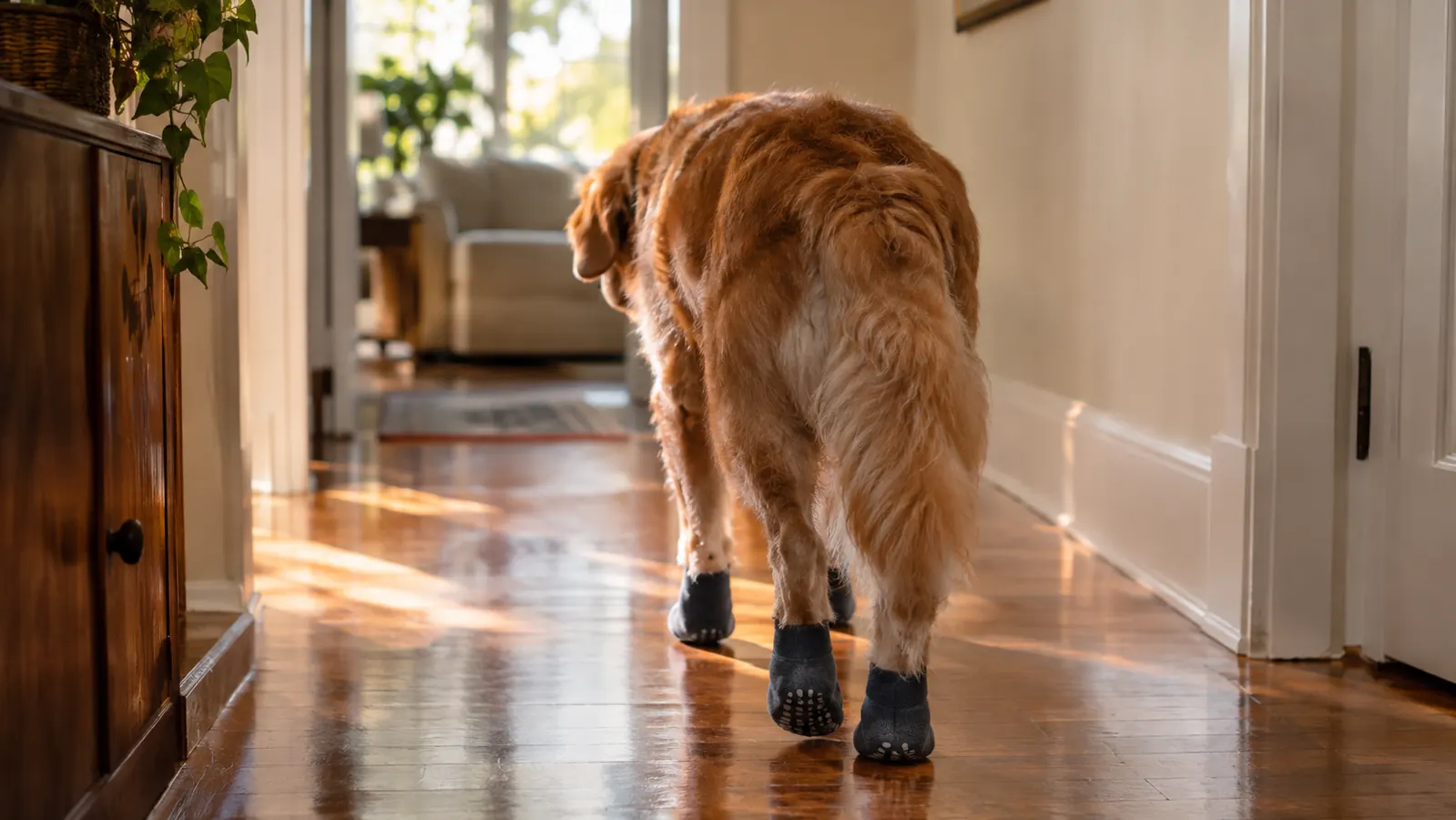
A sock that fits at the start of a walk may not fit at the end. Maple's socks would slowly work their way down her leg if I did not pull them up snug around the ankle, and a sock that slides is worse than no sock, because she would step on the loose fabric and stumble. Now I do a ten-second check before she stands up. I run a finger under the band to make sure it is snug but not tight, I smooth any wrinkles along the top, and I make sure her toes are sitting flat inside instead of bunched up.
I also check her paws after she has worn the socks for an hour, especially in the first week. Her pads needed time to get used to the feel of fabric, and the first two days she would stop and lick at the socks like she was trying to figure out what had happened to her feet. That is normal. If your dog is licking constantly, pulling at the socks, or trying to chew them off, take them off and start the introduction over with shorter sessions. Some dogs simply take longer to accept socks, and there is no shame in that.
Washing the socks is part of the fit routine too. I wash them in cold water and let them air dry, because a sock that shrinks in the dryer is a sock that no longer fits. I wash them every few days, more often in summer when Maple spends time in the yard. A clean sock grips better and slides less, and it also means her paws are not sitting in damp fabric.
Step 5: Build the Socks Into a Routine, Not a Chore
The thing that made the socks work long term is that they became part of Maple's morning, the same way my two-mile walk is part of mine. Every morning, she gets her socks on before breakfast. She stands at the back door, lifts one paw, then the next, and by the time I have her food bowl ready, she is wearing all four and tapping her toes on the hardwood like she is showing off. Consistency matters more than anything else, and I say that as someone who spent thirty years telling kids that showing up every day beats a sudden burst of effort.
She wears the socks for the first few hours of the day, when she is moving between the kitchen, the hallway, and the back door. I take them off before her midday nap so her paws can breathe, then put them back on if she is up and moving in the afternoon. On days when she is stiff, which usually means a cold front came through, she wears them longer. The routine is flexible, but the habit is not. Once a routine is in place, an older dog stops thinking about the socks and just walks.
What Else Helps
Grip socks gave Maple traction on the floors, but they were not the only thing that helped, and I would be doing you a disservice if I pretended otherwise. I trimmed her nails more often, because long nails make a dog's feet slide on smooth surfaces and force the paw to land at a bad angle. I put a non-slip rug with a rubber backing under her food and water bowls, so she had one spot where she could stand on a stable surface while she ate. And I talked to my vet about her hips, because socks fix the floor, not the joint, and any stiffness that is getting worse deserves a professional opinion.
I also slowed down my own expectations. Maple is not going to run around the yard the way she did at six, and no sock, mat, or supplement is going to turn back the clock. What the socks did was remove one specific problem, the sliding, so she could move the way she already wanted to move. If you have an older dog who is slipping at home, start with the floor, fix what you can, and let your vet handle the rest.
One more thing I want to say plainly: I am not a vet, and I do not pretend to be one. Everything in this article is what I observed with Maple in our house, and what worked for her may not work for your dog. If your dog is slipping a lot, or if the slipping started suddenly, that is a conversation for your veterinarian, not an internet article.
Maple went from bracing herself at the kitchen doorway to crossing the floor to check her food bowl in the first week. I watched her do it and I still had to look twice.
If your dog is slipping on hardwood, my honest advice is to try socks before you start rearranging your whole house. They are a small change, they do not require your dog to learn anything new, and they fix the problem at the source, the floor. Give them a week. Watch your dog walk across the kitchen. If you see the same confidence I saw in Maple, you will know they are working.
Stop watching your dog brace before every step
The DOK TigerToes socks gave Maple her confidence back on our hardwood floors. See today's price on Amazon, order a pair, and start the routine tonight. Your dog does not need to be perfect at it on day one, and neither do you.
Amazon Check Today's Price on Amazon →