
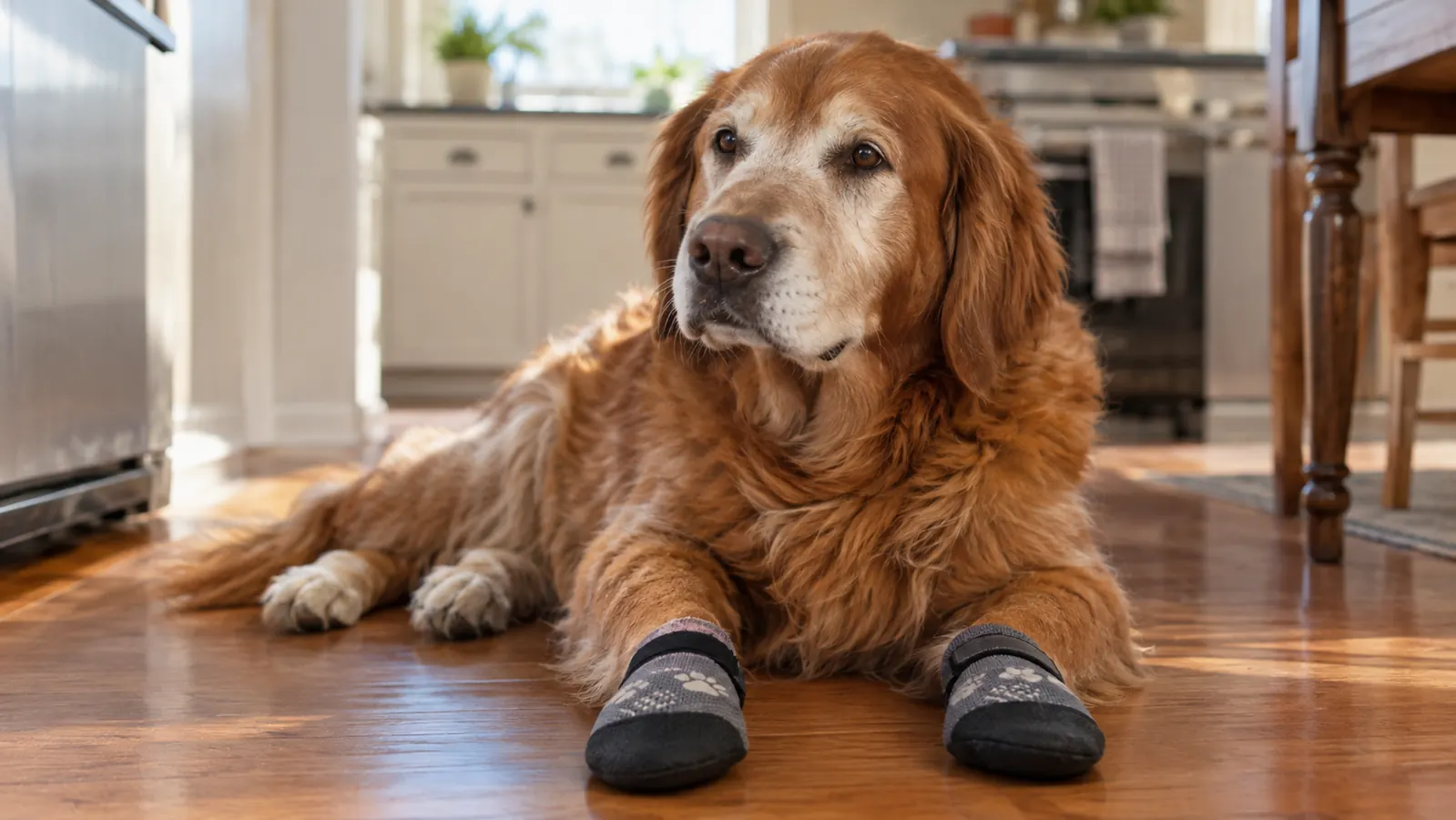
Maple is 11 years old, a yellow Lab, about 70 pounds, and she has the stiff back hips that a lot of older Labs get. She still wants her two-mile walk every morning, but inside the house she had started doing this little shuffle on the hardwood, front feet sliding out from under her when she turned too fast. I caught her once with all four feet splayed like a calf on ice, and that was the moment I started looking for non-slip socks. I am a retired PE teacher, so I think in terms of footing, traction, and preventing the fall before it happens. The DOK TigerToes Premium Non-Slip Dog Socks are what I landed on, and after six months of daily use, I have opinions.
The Quick Verdict
DOK TigerToes gave Maple back her confident walk on hardwood without turning sock time into a battle. They stay on better than any sock I tried, and the grip is genuinely noticeable. They are not a cure for hip stiffness, and they need daily readjusting, but for the specific problem of slipping on smooth floors, they worked.
Amazon Check Today's Price →If your dog does the hardwood shuffle, this is the fix I'd try first
DOK TigerToes are the socks I reached for every single morning for six months. They gave Maple traction on floors she was starting to avoid.
Amazon Check Today's Price on Amazon →How I've Used It
I put the DOK socks on Maple every morning before her walk, and she wears them for most of the day inside. The socks live in a basket by the back door next to her leash, so the routine is the same every single morning: socks on, two-mile walk, wipe her paws, then she can wander the kitchen and hallway without me holding my breath. The socks have a non-slip pattern on the bottom, and the band at the top is what keeps them up. I put them on all four, and the back two do most of the work. Her back end is stiff, and her back feet are the ones that slide.
Before I found these, I tried a pack of cheap socks from the drugstore that were really just human socks with a grip pattern printed on the bottom. They were too thin, the grip wore off in about a week, and Maple slid right through them. The moment that ended it was a Tuesday morning in April. I turned my back to pour coffee and heard her front feet go out from under her on the kitchen hardwood. She caught herself before she went down, but she stood there shaking for a full minute, and I decided I was done with bargain socks. That afternoon I measured her front paw with a cloth tape, about four and a half inches across at the widest point, and ordered the large size of the DOK TigerToes to match the size chart for a dog her weight.
I should say plainly that I am not a vet and I am not making any medical claims. Maple's hips are stiff, and the DOK socks did not fix her hips. What they fixed was the floor. She still gets up slowly, and she still takes a few steps to warm up. But she does not do the splits on the hardwood anymore, and that was the problem I could actually do something about.
What the Grip Actually Feels Like
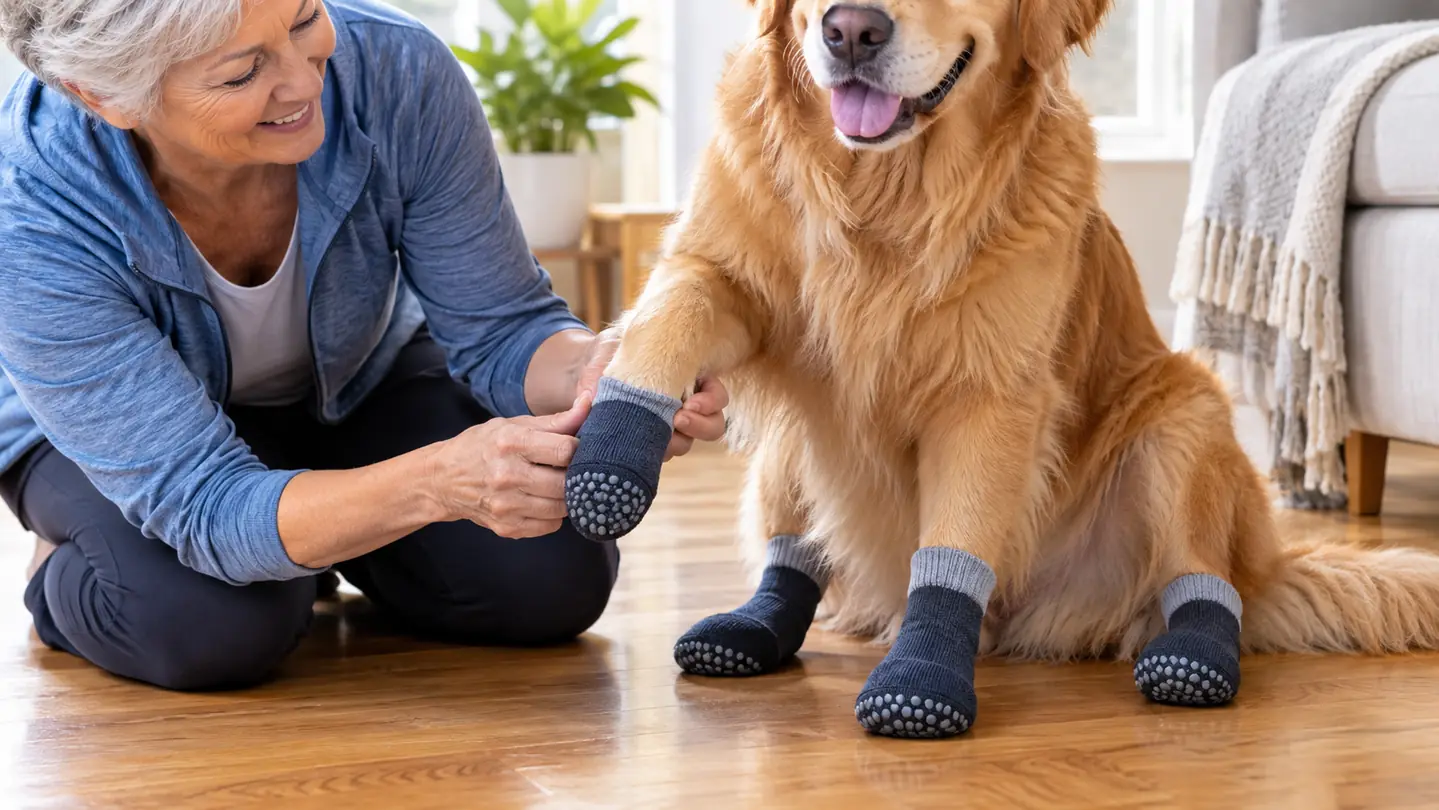
The whole point of a non-slip sock is the bottom, and this is where DOK earns its keep. The grip pattern on the bottom of the TigerToes is what does the work, and on hardwood it makes a real difference. Before the socks, Maple's front feet would slide forward when she stopped, which is exactly how a dog ends up doing the splits and pulling something. With the socks on, she can stop, turn, and pivot without her feet shooting out from under her.
I tested this the way I used to test gym shoes for my students: I watched her walk the same stretch of hallway, back and forth, with and without the socks. Without them, her front feet slid on every turn. With them, she planted and turned cleanly. The difference was not subtle. It was the difference between a dog who walks carefully and a dog who walks normally.
The clearest proof came on a Saturday in May when my grandkids came over. Maple gets excited when they arrive, and excitement means fast turns. Before the socks, a fast turn on the hallway hardwood meant her front feet slid and she ended up with her chest on the floor. That Saturday she spun around to meet them at the back door, planted, and turned back to me with her feet underneath her the whole time. She did not do the little hesitation step at the kitchen doorway that she had been doing since the winter, and when I called her to come, she stopped clean instead of sliding past me. I did not tell the kids I was watching, but I was watching. That is the moment I stopped thinking of the socks as a gimmick and started thinking of them as part of her daily gear, right up there with her collar and her leash.
One thing I will say honestly: the grip has limits. On a wet floor, or on a floor with a layer of dust, the socks are less effective. The day the floors were mopped and Maple walked through the hallway before it dried, I watched her hesitate on every step, so now I keep her in the living room until the floors are fully dry. I also would not trust them on wet stairs. We have three back porch steps, and I stay beside her on those. The socks are for flat, dry surfaces. That is their job, and they do it well.
The difference was not subtle. It was the difference between a dog who walks carefully and a dog who walks normally.
How They Fit and How Long They Last
Maple is a 70-pound Lab with big paws, and I was worried the socks would be too small or too tight. The DOK TigerToes come in sizes, and I ordered the large. They fit her front paws with a little room to spare, and the band sits above her ankle without digging in. I have left them on her for six or seven hours at a time, and when I take them off, there are no red marks or rubbed spots. That tells me the fit is right.
Putting them on got easier once I figured out the trick. I gather the sock up like a tube, slip it over her toes, and pull the band up over her ankle in one motion. If I try to push it on flat, the toes bunch up inside and she gives me a look that says I am doing it wrong. Maple is patient about her feet, which helps, but even a patient dog has a limit, and the gather-and-pull method takes about twenty seconds per paw. One more fit note: the band sits high enough that it does not rub against her dewclaw, which the cheap drugstore socks did constantly.
Durability surprised me. I expected to be replacing socks every few weeks, because Maple is not gentle on anything. Six months in, the original four socks are still intact. The grip pattern on the bottom has worn down a little on the pair she wears most, but they still grip. The elastic band has stretched slightly, which means I adjust them a bit more often during the day, but they have not lost their shape. Around month five I noticed the grip on her favorite pair had flattened a little, so I swapped that pair to her back feet and put the newer pair up front. That rotation has kept all four going. For the money, I consider that good value.
The one thing I will flag is that they are socks, not boots. They are not waterproof, and if Maple steps in a puddle, the sock is wet and needs to come off. I mostly use them indoors, and I swap to a dry pair after the walk. For the specific job of hardwood, the DOK socks are the right tool.
The Downsides Nobody Mentions
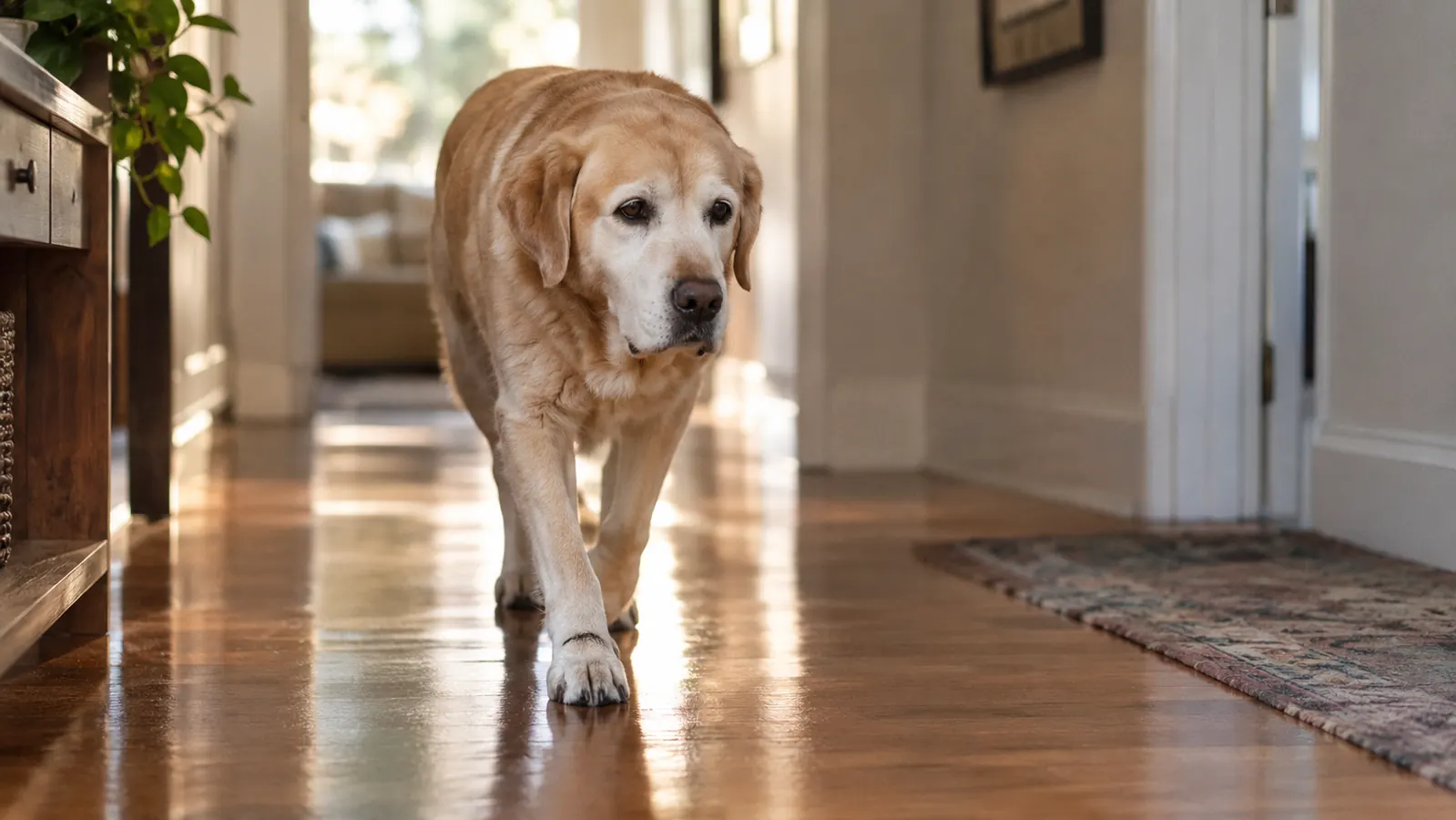
Let me be fair and list the things that annoyed me, because every review should have a cons list. First, the socks do slide down a little over a long day. The band helps, but it is not perfect. On a long Sunday when the grandkids are here and Maple is up and down all afternoon, I push the back socks back up three or four times. The front ones barely move. I also learned that a twisted sock is worse than no sock: if the sock rotates so the grip is on top of her foot, she slides more, not less. The fix is a two-second check every time I walk through the kitchen, which sounds like a hassle and is not. For Maple, the front socks stayed put much better than the back ones.
Second, Maple can get the socks off if she really wants to. She figured out that she can hook the band with her back foot and pull, and she has done it exactly four times in six months. The first time I found the sock under the coffee table, damp and twisted, and she looked very pleased with herself. Every time it has happened, the sock was sitting crooked before she started working on it. When the sock is sitting straight, she leaves it alone. If your dog is determined, no sock on the market will stay on. The DOK socks are better than the cheap ones I tried, but they are not escape-proof.
Third, you have to keep the socks clean. A dirty sock loses its grip, and a sock that has been through the wash a dozen times is not as grippy as a new one. Maple steps in her water bowl about once a week, and a damp sock picks up dust and hair from the floor, which makes the bottom slick. I wash the socks in the washing machine on cold with no fabric softener and air dry them over the shower rod, and that has kept them working. It is a small chore, but it is a chore. If you are not willing to do laundry, you are not ready for dog socks.
What I Liked
- Genuinely noticeable traction on hardwood and tile
- Stayed on better than any other sock I tried
- Survived six months of daily wear by a 70-pound Lab
- No rubbing or red marks, even after full days
- Machine washable, and two pairs let you rotate while one dries
- Maple stopped avoiding the kitchen floor
Where It Falls Short
- Back socks slide down and need readjusting
- Not for wet floors or stairs
- A determined dog can still pull them off
- Grip fades slowly after many washes
Who This Is For
DOK TigerToes are for the dog who is still mobile but starting to lose confidence on smooth floors. If your dog hesitates before stepping onto the kitchen floor, if their front feet slide when they stop, if they do the shuffle instead of a normal walk, these socks are worth trying.
They are especially good for older dogs like Maple who are not ready for a full mobility aid but need a little help. A sock is a low-commitment intervention. It is not a harness, not a brace, not a ramp. It is a piece of fabric with grip on the bottom, and for a lot of dogs, that is exactly enough. If your dog is slipping on hardwood, I would try these before I tried anything more complicated.
Who Should Skip It
Skip the DOK socks if your dog has a serious mobility problem that needs a vet, not a sock. If your dog is dragging their back legs, falling frequently, or unable to stand, do not buy socks. Go to the vet. Socks are a comfort and traction tool, not a treatment for a medical condition. I say this as someone who loves Maple more than anything: a sock will not fix a bad hip, and it should not be used as a reason to delay a vet visit.
Also skip them if your dog hates having their feet touched. Maple is patient about it, but I have known dogs who will not let you near their paws, and putting socks on them twice a day would be a fight. If that is your dog, you are better off with a different solution, like a runner rug on the worst stretches of floor.
Six months in, I'd buy them again without hesitating
DOK TigerToes gave Maple her confidence back on our hardwood floors. If your dog is doing the shuffle, this is the simplest fix I found.
Amazon Check Today's Price on Amazon →