

Maple is an 11-year-old yellow Lab, about 70 pounds, with back hips that have gotten stiffer every year since she turned nine. She still greets me at the door, still follows me into the kitchen, still does her happy little waddle when the grandkids come over on weekends. But she gets up slow after naps, and she hesitates at the back porch steps in a way she never used to. When I started shopping for an orthopedic bed, I figured any thick foam rectangle would do. I was wrong, and I want to save you the trial and error.
I am a retired PE teacher, so I tend to think about joints the way I thought about my students' fitness: consistency beats gimmicks, and the right support makes everything else easier. After a lot of measuring, comparing, and watching Maple actually use the bed I picked, here is the step-by-step process I would walk through again, plus the one bed that ended up in our living room, the JOYELF XLarge Memory Foam Dog Bed.
The bed that finally got Maple to sleep through the night
After trying a flat cushion and a cheap foam pad, the JOYELF XLarge Memory Foam Dog Bed is the one Maple actually settles into. Check today's price on Amazon and see if it fits your dog's size and needs.
Amazon Check Today's Price on Amazon →Step 1: Measure your dog, not the room
Before you look at a single bed online, measure your dog from the tip of the nose to the base of the tail while she is standing in a normal position. Then add six to eight inches. That number is the minimum bed length you want. Maple is about 34 inches nose to tail, so I needed a bed in the 40 to 42 inch range. The JOYELF XLarge comes in at roughly 40 by 32 inches, which gives her room to stretch out without hanging off the edge.
Do not measure the space in your living room first and then try to squeeze a dog into whatever fits the corner. I almost bought a medium bed because it looked better next to the couch. Maple would have been curled in a tight ball every night, and a dog with stiff hips does not want to sleep in a tight ball. Measure the dog first. The bed can go almost anywhere, but your dog's joints have to fit inside it.
Also think about how your dog actually sleeps. Maple starts out stretched on her side, then curls up around 3 a.m. A bed that is only long enough for one position will leave her hanging off the edge in the other. That extra six to eight inches is what makes the bed work for both positions. I learned this the hard way with a 36-inch cushion that left her back legs on the hardwood every single night.
Step 2: Look for thick, supportive foam, not just softness
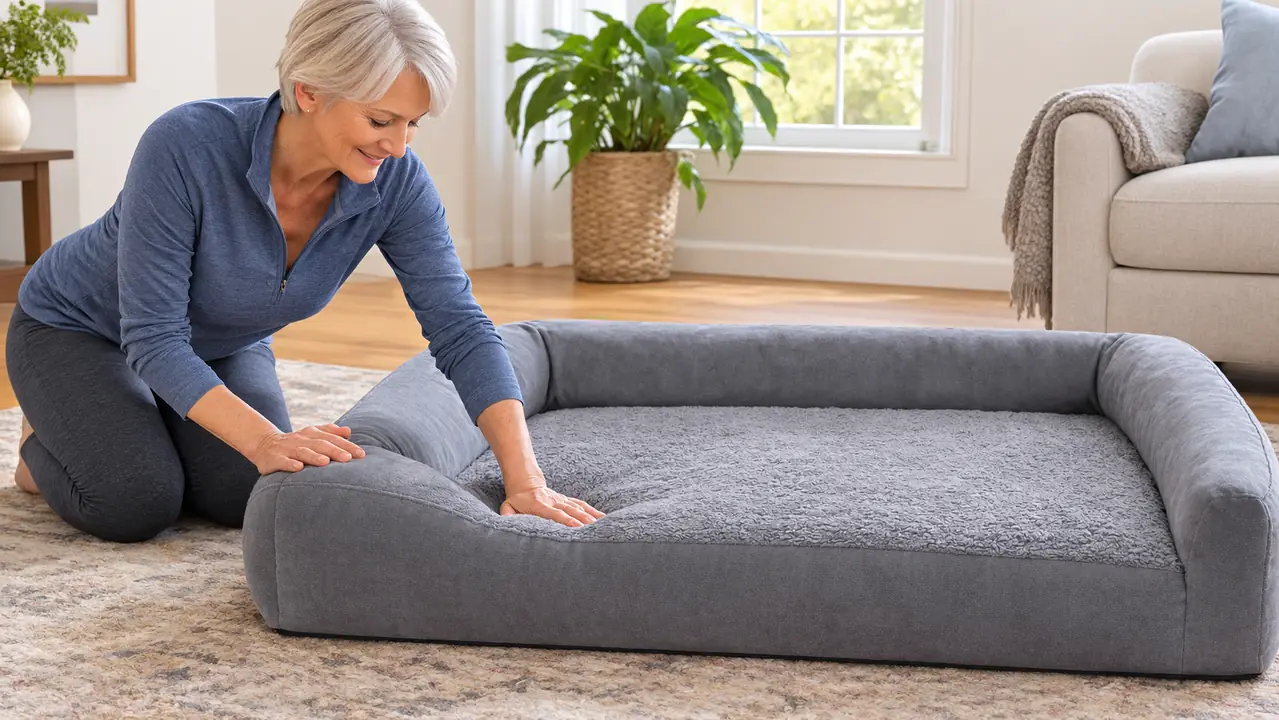
Here is the mistake I almost made: I pressed my hand into a bed in a store, felt something squishy, and thought it was perfect. Soft is not the same as supportive. An arthritic dog needs foam that holds its shape under her weight, so her hip doesn't sink down to the floor. The JOYELF bed uses a thick memory foam base that supports Maple's 70 pounds without bottoming out. When she steps off the bed, the foam springs back instead of staying dented.
A good test is to press your palm into the foam and see how slowly it recovers. If it springs back instantly, it is probably too soft. If it takes a few seconds, that is the kind of slow support that cradles a sore hip. I also look for a bed with a solid foam base rather than a thin layer of padding over a hollow center. Some cheaper beds look plush on top but offer almost nothing underneath.
I also do what I call the elbow test, because a dog's elbows and hips are where the weight really lands. Kneel down and put your elbow on the bed with some of your weight behind it. If you can feel the floor through the foam, a 70-pound dog like Maple will feel it too, every single night. On the JOYELF bed my elbow sank in and stopped well short of the floor, which is exactly what you want for a heavy, older dog who lies in one spot for hours.
The JOYELF bed has a raised edge on three sides, which gives Maple a place to rest her head and a sense of being tucked in. The center is where the support matters most, and that is where the thick foam does its job. If you can feel the floor through the bed when you press down, keep looking. I made that mistake with a foam pad from a big box store, and within a month Maple was sleeping on the floor next to it.
Step 3: Check the cover before you check the price
An orthopedic bed is only as good as its cover, because you are going to wash that cover a lot. Maple is a senior dog with senior dog accidents, and she also tracks in mud from the backyard. The JOYELF bed has a removable, washable cover with a zipper, and I have washed it at least six times in the months we have owned it. It comes off easily, goes in the washing machine, and goes back on without a wrestling match.
Look for three things in a cover: a full zipper that actually opens all the way, fabric that survives repeated washing without pilling, and a bottom that does not slide across hardwood floors. Our kitchen and hallway have hardwood, and the JOYELF bed has a non-slip bottom that stays put when Maple climbs in and out. A bed that slides every time your dog steps on it is a bed your dog will stop using.
I also learned to check whether the cover is truly removable or just decorative. Some beds advertise a washable cover but the zipper is hidden under a seam and practically impossible to use. Read the reviews for the words 'zipper broke' or 'could not get the cover back on.' Those reviews will tell you more than the product photos ever will. The first cover I bought had a zipper that snagged halfway around, and I had to cut the whole thing off with scissors.
Step 4: Watch how your dog actually uses the bed
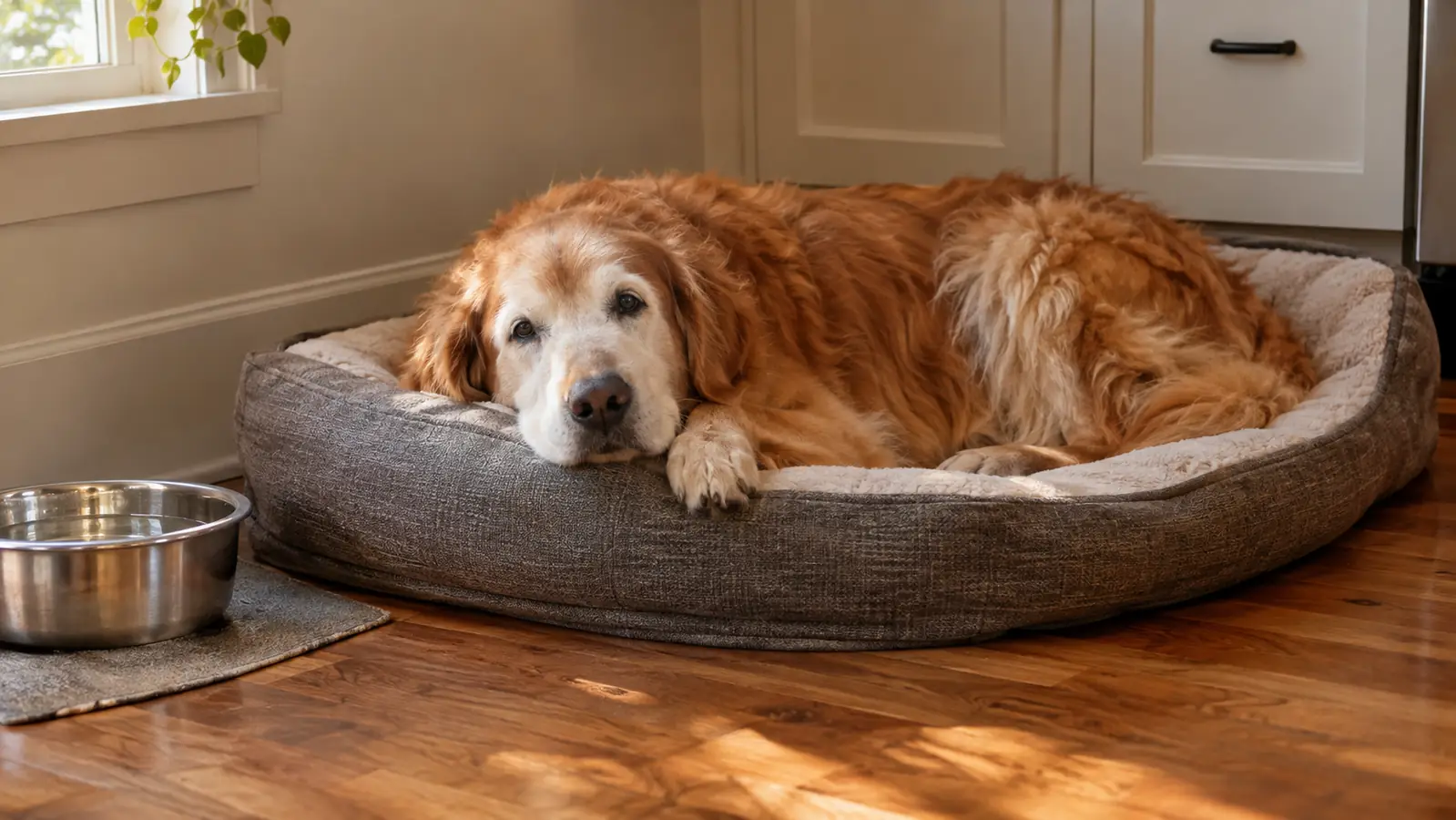
The real test is not how the bed looks in the listing. It is what your dog does when the bed is on the floor. The first night we put the JOYELF bed in the living room, Maple walked around it twice, sniffed it, and then stepped in and turned in a circle before lying down. She slept there for three hours, which was longer than she had slept on the old flat cushion in months.
Give your dog a week before you decide. Some dogs take a few days to trust a new bed, especially if their joints hurt and they are used to a familiar spot. Leave the bed in the same place, put an old t-shirt that smells like you on it, and let her find it on her own. Maple was wary of it for the first two days, then claimed it completely. Now she gets grumpy if I move it to vacuum.
During that first week, put the bed where your dog already likes to rest instead of where it looks nicest. Maple has napped in the same patch of sun by the living room window for years, so that is where the JOYELF went. If you move the bed to a corner your dog never visits, you are testing the location, not the bed, and you may give up on something that would have worked.
Watch for the signs that the bed is working: your dog stays on it for longer stretches, gets up more easily after a nap, and chooses the bed over the floor or the couch. Those are the signs that matter. If your dog keeps avoiding the bed after a week, the size, the foam, or the location is wrong, and it is worth rethinking the choice. I kept a little notebook for the first two weeks and wrote down what time Maple got on the bed and how long she stayed. The pattern was obvious by day ten.
Step 5: Match the bed to your dog's changing needs
A senior dog's needs change faster than you expect. The bed that works at age nine might not be enough at age eleven. When Maple started hesitating at the back porch steps, I also noticed she was sleeping more and moving less. That is when I stopped looking at flat beds and started looking at orthopedic beds with a thick foam base and raised edges. The JOYELF bed gives her the support she needs now, and it gives me peace of mind that she is not lying on a hard floor.
Think about the future, too. If your dog is already showing signs of stiffness, buy the bed that fits her current size and weight, not the bed that fit her five years ago. A bed that is too small or too soft will not help as her joints get stiffer. I would rather buy one good bed now than two mediocre beds over the next two years. That is the same math I used when I bought good shoes for my students instead of cheap ones that wore out by December.
And remember: an orthopedic bed is part of a bigger picture. I still take Maple for her two-mile morning walk, I keep her at a healthy weight, and I check with our vet about her hips. The bed is not a treatment. It is comfort, and comfort matters a lot when you are eleven years old and your hips are tired.
What Else Helps
A good bed is the foundation, but a few other things made a real difference for Maple. I put a non-slip rug runner on the hardwood floor between her bed and the back door, because she was sliding when she stood up. I also moved her water bowl closer to the bed so she does not have to walk across the kitchen in the middle of the night. And I kept her on a consistent routine: same walk time, same meal time, same bed time. Dogs with sore joints do better with predictability.
I also learned to watch her body language. When Maple starts licking her hip or hesitating at the steps, I know she needs a slower day. I do not push her on those days. The bed gives her a soft place to recover, and the routine gives her a sense of safety. If you are unsure about what your dog needs, talk to your vet. I am not a veterinarian, and I do not pretend to be one. I am just a woman who has spent a lot of time watching an old dog rest.
The first night Maple slept on the JOYELF bed, she stayed put for three hours. That was longer than she had slept on the old flat cushion in months.
Give your stiff old dog a soft place to land
The JOYELF XLarge Memory Foam Dog Bed is the one that worked for Maple. Check today's price on Amazon and see if it is the right fit for your dog.
Amazon Check Today's Price on Amazon →