

Maple is 11 years old, a yellow Lab who weighs about 70 pounds, and she has spent the last two years letting me know her hips are not what they used to be. She still greets me at the door, but she does it slower. She still wants her morning walk, but she takes the back porch steps one at a time. Around age nine she started hesitating at the car door, and I started doing what I did for thirty years as a PE teacher: I made a plan. This is the routine that came out of it, built around a joint supplement from Nutramax Laboratories called Dasuquin MSM, and I want to walk you through it step by step.
I am not a veterinarian, and nothing here replaces a conversation with yours. What I can give you is what I actually did, in the order I did it, with the observations I wrote down along the way. If your dog is stiff in the morning, slow to rise, or suddenly unsure about steps she used to take at a run, this is the framework I wish someone had handed me two years ago.
Start with a supplement your vet is comfortable with
Nutramax Laboratories Dasuquin MSM soft chews are the ones I settled on after comparing ingredient lists for a week. They are formulated for large dogs, and the soft chew form made the daily routine painless.
Amazon Check Today's Price on Amazon →Step 1: Talk to your vet and get a baseline
Before I bought anything, I made an appointment. Our vet watched Maple get up from the floor, watched her walk down the hallway, and felt along her back hips while Maple leaned into her the way Labs do. She told me what she always does: keep Maple lean, keep her walking every day, and a joint chew was worth trying as part of that routine. She also gave me a number to track, which turned out to be the most useful thing she did.
The number was simple. On a scale of one to ten, how hard is it for Maple to get up from a nap? That week she was a seven. I wrote it on a sticky note and put it on the fridge. I also timed how long it took her to come down the three back porch steps in the morning. That first week it was about eleven seconds, with a pause on the middle step every single time.
Write down your own numbers before you start. A stiffness score, a step time, a distance she can walk before she slows down. You cannot tell if something is working if you do not know where you started.
Step 2: Pick a supplement with ingredients worth the money
I spent a full week reading labels, and I will be honest with you, most of them blurred together. What finally made the difference was learning what the ingredients actually do. Glucosamine and chondroitin are the building blocks of cartilage, the cushioning material that wears thin in arthritic joints. MSM, which stands for methylsulfonylmethane, is a sulfur compound that supports the connective tissue around the joint. A supplement that has all three, in meaningful amounts, is doing real work.
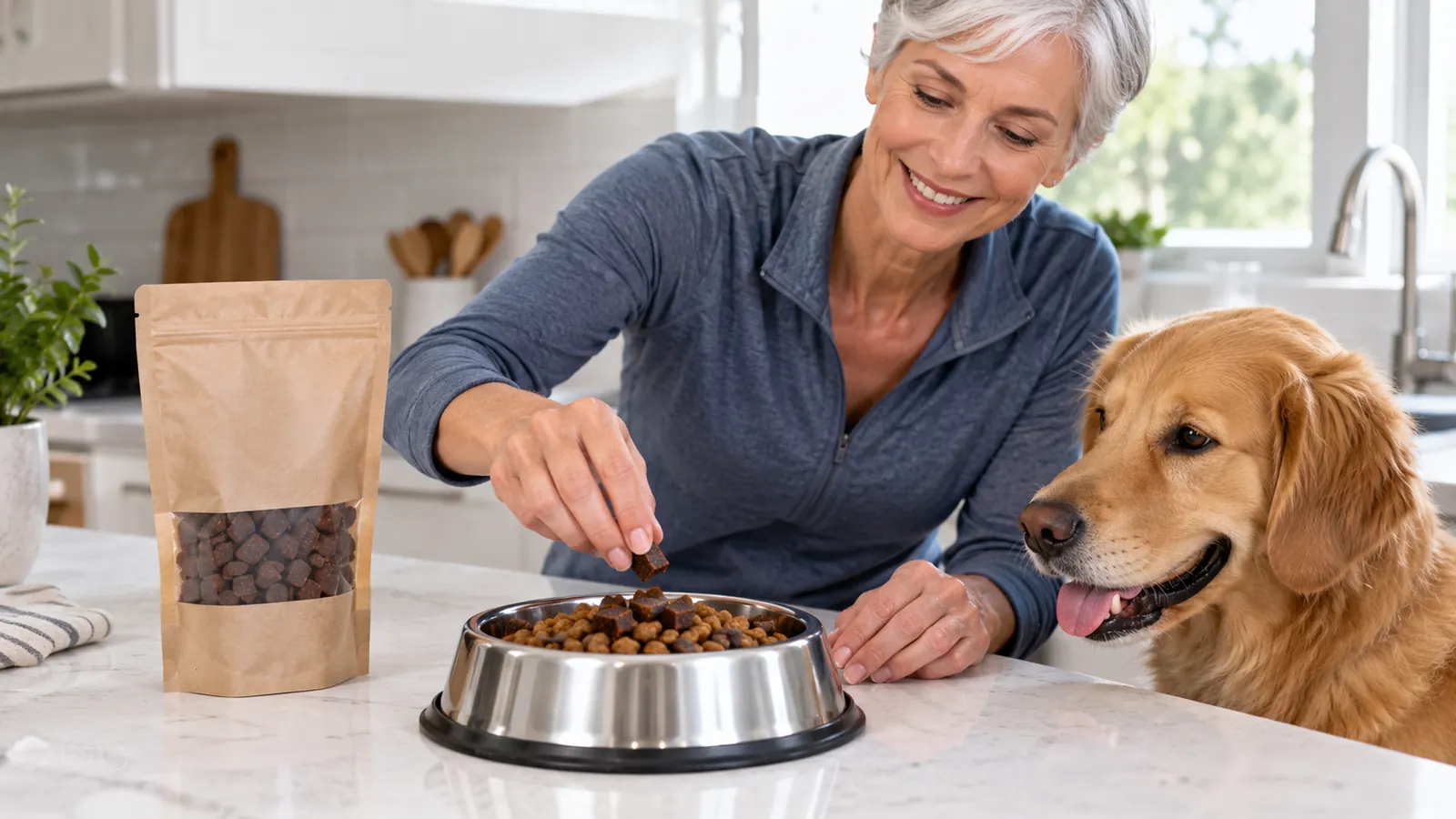
Nutramax Laboratories makes Dasuquin MSM, and it was the ingredient list that won me over. The company has been making joint supplements for decades, and the Dasuquin line is the one our vet mentioned by name before I ever asked. The soft chews for large dogs combine glucosamine, chondroitin, and MSM in one daily dose, and the chews are soft enough that Maple thinks they are a treat. That matters more than you would think, because a supplement you have to fight to give is a supplement you will eventually stop giving.
One more thing I checked: the serving size. Some supplements look cheap until you realize the dog needs four chews a day. With Dasuquin MSM for large dogs, the routine is one chew a day for Maple's weight, and the 84-count tub lasts close to three months once you are past the loading weeks. That is the math that matters.
Step 3: Start slow and give it a full six weeks
Joint supplements are not pain pills. They do not work in an hour, and they do not work in a week. Joint supplements are a slow routine, which means the supplement needs time to build up in the system. Most manufacturers recommend a loading period, and Nutramax Laboratories recommends a double dose for the first four to six weeks before dropping to the maintenance dose. I followed that exactly, and I am glad I did.
The first two weeks, I noticed nothing. Maple was still slow to rise, still paused on the middle porch step, still gave me the same look when I opened the car door. I almost stopped. On day eleven I nearly skipped the chew entirely, telling myself the whole experiment was a waste of good money. I am glad I did not. Instead of quitting, I wrote a note on the fridge: give it until the end of May before you decide. By the end of May the morning routine looked different. She did not suddenly run to the car. She just stopped hesitating, and that was enough. I want you to have a deadline like that, because without one I would have quit right before the supplement started working. I am telling you this because I want you to expect it. If you start a joint supplement and see no change in week one, that is normal, not a sign of failure.
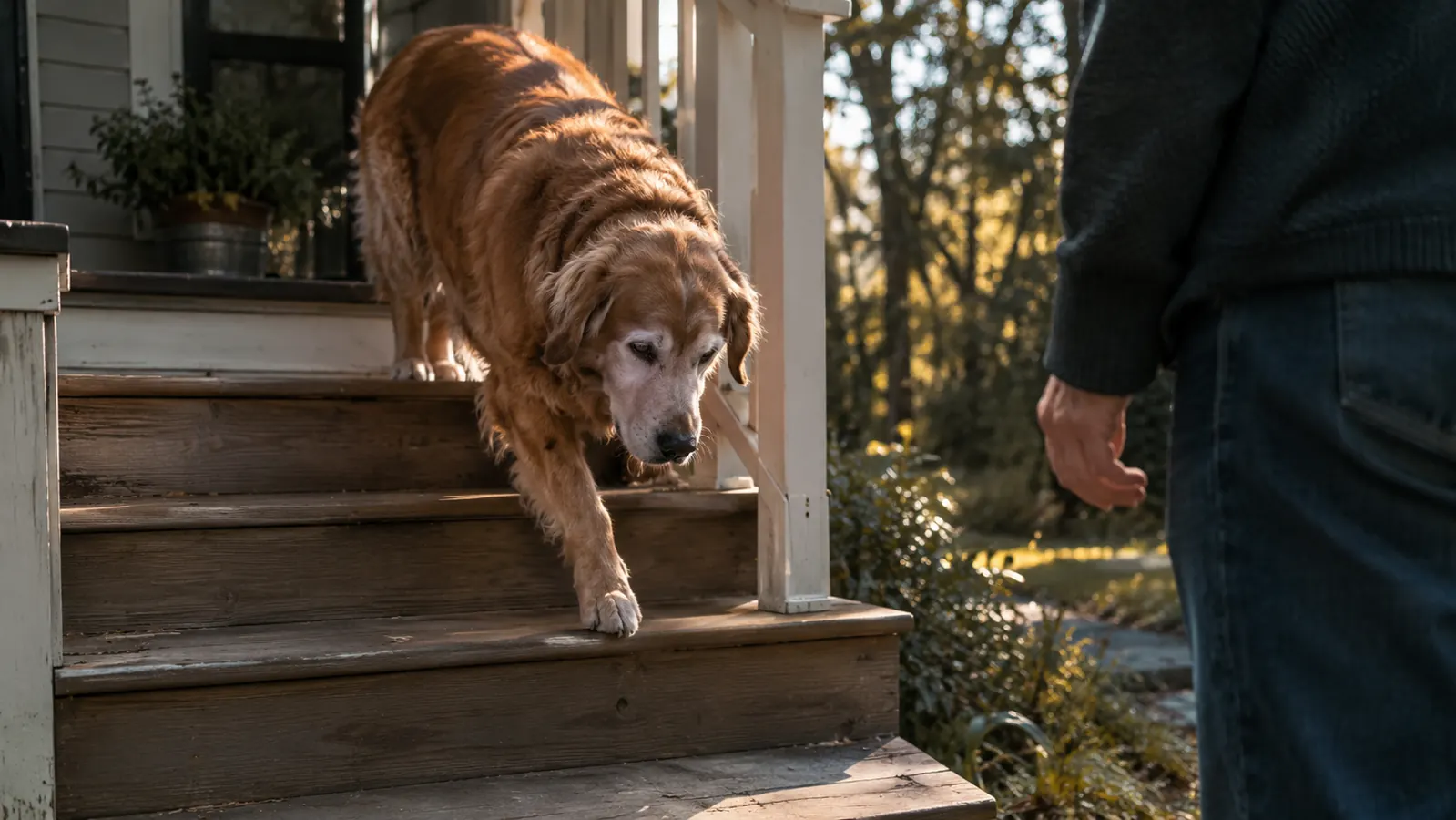
The change showed up around week four. Maple started getting up from her naps in one motion instead of two. She still stretched first, but the hesitation was gone. By week six, her stiffness score had gone from a seven to a four, and she was taking the porch steps in about six seconds with no pause on the middle step. I wrote both numbers on the same sticky note, right under the originals.
Step 4: Pair the supplement with the right kind of movement
A supplement does its best work when it is paired with movement that keeps the joints from stiffening further. For Maple, that means a slow start instead of a hard push. We keep our two-mile morning walk slow to start, after she has had time to wake up and move around the house a little. The morning walk starts slow, with plenty of sniffing, and we save the faster pace for the second half when her body is warm.
I also added a few minutes of gentle stretching to our routine, the same way I used to start a PE class. I run my hand along her back legs and gently extend each one a few times before we head out. She stands for it, which I take as approval. The goal is not exercise for its own sake. The goal is to keep the joints moving through their full range so they do not lock up overnight.
Warmth helps too. On cool mornings I let Maple take a few minutes to move around the kitchen before we go out, and I have learned to let her set the pace. Some days she wants the whole loop. Some days she turns for home after ten minutes. I let her decide, and I do not push. Consistency over gimmicks, the same rule I used with a gym full of seventh graders. I remember the morning I finally trusted the routine. It was a cool Tuesday in September, and Maple walked the whole loop without stopping once, something she had not done since before Christmas. I did not celebrate by pushing her further. I celebrated by letting her nap in the sun on the porch, which is her favorite thing in the world. That walk taught me the difference between exercising a dog and listening to one. If I had pushed her every day the way I did when she was five, we would have both been miserable. Instead, we found a pace that works, and she reminds me of it every time she turns for home.
Step 5: Watch the small things and adjust as you go
The sticky note on the fridge became a habit. Every few weeks I recheck Maple's stiffness score, her porch step time, and how far we walk before she slows down. The numbers tell me what my eyes might miss, especially on days when I am worried and looking for problems. If her score creeps back up, I know to cut the walk distance for a few days and let her rest.
I also watch the small things that do not show up on a scale. Is she eating normally? Is she still interested in the grandkids when they visit on weekends? Is she still meeting me at the door, even if she takes her time? Those are the signs that matter most, because a dog in real pain does not care about the door. Maple still cares, and that tells me the routine is working. Last weekend, one of the grandkids spent the night, and Maple followed him from the living room to the kitchen and back three times, just to be near him. Ten years ago she would have been bouncing off the furniture. Now she was trotting, but she was moving, and that was enough for me. The grandkids have learned to sit on the floor beside her instead of expecting her to jump up, and they take turns giving her the gentle ear scratches she has always loved. It is not the same dog I brought home as a puppy, but she is still the same dog where it counts.
If you notice your dog getting worse instead of better, or if she seems genuinely uncomfortable, do not wait six weeks to call the vet. Supplements support healthy joints. They do not fix everything, and they are not a substitute for medical care. I check in with our vet twice a year now, and I always bring my sticky note.
What Else Helps
The supplement is the centerpiece of our routine, but it is not the whole routine. A few other things made a real difference for Maple. I put a nonslip runner on the hardwood floor in the hallway, because watching her back feet slide on the wood was the thing that first made me cry about her getting older. And I moved her bed out of the corner, where she used to wedge herself, to a spot in the middle of the living room where she can get up without backing out of a tight space.
Weight matters more than any of it. Maple is a big-boned Lab, and keeping her at a healthy weight is the single best thing I do for her hips. Every extra pound is extra load on those joints, so I measure her food, I count the training treats, and I do not let the grandkids sneak her table scraps no matter how hard they lobby. A lean senior dog moves better than a heavy one, full stop. At her last checkup, the vet said she was 70.4 pounds, almost exactly where she was at her healthiest. I count that as a small victory I earned one measured scoop at a time. I also stopped free-feeding years ago, so every bite she eats goes through my hands first, and that gives me a chance to notice if her appetite changes. When her appetite did dip for a few days last winter, I caught it early because I was the one scooping her food, and the vet said that kind of early warning is worth more than any supplement.
By week six, her stiffness score had gone from a seven to a four, and she was taking the porch steps in about six seconds with no pause on the middle step.
Give the routine six weeks before you judge it
Nutramax Laboratories Dasuquin MSM soft chews for large dogs are the ones on our fridge, and the 84-count bottle means you will not be reordering every two weeks. Start the loading dose, mark your calendar, and let the numbers tell you the truth.
Amazon Check Today's Price on Amazon →